Sunday, January 20, 2013

Shane's Favourite Movies of 2012

It's that time of year again. Time to look back and relive some favourite cinematic experiences of the year. Sadly, I'm still frantically trying to catch up on all the films I wanted to see from 2012.

I dropped the annual "Most Hated Movies of the Year" list a while back, but I'll quickly mention that Project X was the shittiest movie I saw in 2012. Here's your trophy, Project X, for being annoying, frustrating, and devoid of entertainment or value. Aside from that I felt it was a strong year of films and I struggled making a final decision on the top 5. Here we go...

5) Skyfall
Absolutely one of my favourite Bond films ever. Great pacing, solid action, and f'ing gorgeous cinematography. In fact, it might be the best looking film of 2012 for its beautiful shots.

Judi Dench and Javier Bardem are both really enjoyable to watch, and for people who think there was too much M in the movie ... you're crazy. Plus Bardem was a sufficiently creepy villain, who felt truly menacing. It was refreshing to see a Bond film where I actually felt tense. Daniel Craig is not the perfect Bond we've seen in the past, important characters can be in danger, and actions actually have meaningful consequences. I much prefer that over 007 outracing space lasers and whatnot.


4) The Dark Knight Rises
First of all, The Dark Knight Rises doesn't reach the same level as the films before it. How could it really? Batman Begins was like a comic book dream come to life, and The Dark Knight broke through the comic movie shell and was an astounding film in practically every way.

Anne Hathaway was wonderful as Catwoman, and it was great to see Bane living up to his imposing reputation (though I don't know if I'm sold on that voice yet, as memorable as it was). Like the previous film, TDKR felt like it was compacting two films worth of story into one, but I have to say that it didn't work as well this time around. At times the story felt disjointed and the editing made the film feel like a montage rather than a natural flow from one scene to the next. However, the chaos and destruction that Gotham suffers was exciting, and watching Batman take back the city is enough to give me goosebumps.

The biggest praise I can give TDKR is that it wraps up the trilogy in the most satisfying way possible. I may have had some problems with the film, but believe me when I say that I love it. Even the worst Nolan Batman film is leagues ahead of the previous Batman franchise. I suppose I'm just greedy, but maybe some disappointment came from knowing the ride is over.

3) Moonrise Kingdom
In a world where kids are mature, and adults are childish, a strange love story plays out in the wilderness as two troubled kids run away together. I would describe this movie as an adorable comedy. It's got everything you'd want from a Wes Anderson film; the bright vibrant design, quirky and flawed characters, an almost mathematical approach to cinematography and camera movement, and a completely charming atmosphere.

I wish the third act was as strong as the rest of the film, but aside from that it's a great movie. The kind that I can see myself watching numerous times in the future. Even if you don't consider yourself a Wes Anderson fan, I would give Moonrise Kingdom a shot. It's funny and charming enough to appeal to everyone.


2) Django Unchained
My immediate reaction to Django was, that wasn't quite what I expected, and I thought at first that I was disappointed. But the more I thought about it, the more I loved it. The characters and story are compelling, there's a wonderful mix of comedy, drama, and action. As you would expect it pays homage to spaghetti westerns, but there are some seriously amazing performances here, with DiCaprio standing out for his intense portrayal of plantation owner, Calvin Candie.

The movie is always teetering between charming Southern hospitality and vicious bloodlust. Like a lot of Tarantino's films, there are long scenes of suspense that erupt in a climax of exaggerated violence. It's simply spectacular. In this world every human is a pressurized canister of blood ready to burst at any moment. It was a lot of fun, and I can't wait to watch it again.


1) The Avengers
Easily the most fun I've had at the cinema last year. I saw all the individual superhero films that lead up to this collaboration, and when I finally got to see Avengers assemble ... it was a spectacle that filled me with genuine glee. I haven't been this delighted by superheroes fighting side by side since The Incredibles. Don't get me wrong, I love the current Batman trilogy, but Nolan's Batman is an entirely different beast from the Marvel movies. They are both wonderful for different reasons. You could compare them as "gritty comic realism" and "flashy comic fantasy".

The movie is strongly written with excellent pacing and truly hilarious moments. There's a fine balance between the comic titans, giving them all ample opportunity to enjoy the spotlight. Characters that I expected to be lesser "filler" heroes managed to win me over by the end. It was refreshing to see each character shine, work together creatively, and behave in ways that seem true to their personality. Plus, I goddamn love the Hulk in this movie. It only took three tries, but they finally nailed it.

All in all, Avengers did everything I hoped for. Many other films in 2012 left me with nagging issues, but The Avengers got right to the point and delivered a great action hero experience. The only thing that bummed me out was knowing I'll have to wait for the next team-up.

Friday, October 12, 2012

Best Batman Artists

As he's easily one of the most iconic and enduring characters in all of comics, Batman has been drawn by a LOT of different artists over the decades.  Coming up with the five best to do so is basically impossible but it's also fun to try. Naturally, a lot of good artists didn't make the cut but I will try to mention them where I can.

Probably the most celebrated artist of Batman's earliest days is Dick Sprang - whose square-jawed, barrel-chested Batman, while not very anatomically accurate, was very visually striking and helped lay the groundwork for all depictions that followed. (Although it should be noted there were others before him.) Nowadays the style can be criticized as being overly cartoony and simplistic but what it comes down to is that it is still unmistakenly Batman.

In the mid-sixties Carmine Infantino introduced a Batman that was more realistic-looking and better fit the stories that were being told, as Batman moved away from the goofier stuff he'd been involved in in the fifties. It's not a look that I particularly enjoy myself though. It just wasn't dynamic enough for my tastes. And the way he drew the mouth actually kinda bugs me - too much emphasis on the lips or something. But that's just nit-picking, really.

It really hurt to not be able to include the late Gene Colan for the work he did in the first half of the eighties. In the seventies he'd been the artist for Marvel's Tomb Of Dracula series and he really brought that shadowy, horror style to Batman and Gotham which worked extremely well. He really keyed on the idea that when Batman suits up and goes out he becomes a sort of creature of the night.

I could go on of course but let's get to the list, where some of those who didn't get entries are at least mentioned.

5. Tony Daniel
I really wanted to put Andy Kubert, son of the legendary Joe Kubert and brother of Adam, in this spot but ultimately decided he hasn't done quite enough Batman so far to warrant it. So I went with the artist whose Batman looks the most like Kubert's to me - Tony Daniel. He's also the artist who took over for Kubert working with writer Grant Morrison. He drew Batman: R.I.P. as well as the followup Batman: Battle for the Cowl. When The New 52 started, he was the artist as well as writer for the first twelve issues of Detective Comics, plus one annual and an issue #0.

Drawing with a very noir-influenced style, Daniel has to be the most definitive Batman artist of the last few years at least. I especially love how he does the cape - in some shots it looks almost endless as it flows out behind our dark hero. It reminds me a bit of Tim Sale's version of the character, which is a good thing.

I also really like that Daniel has a real feel for Batman's physique and how it differs from other characters like Nightwing (especially important given he's drawn Dick Grayson as Batman - please note that the picture here is of the Bruce Wayne version). Batman's official height and weight is 6'2, 210 - he's a big, broad-shouldered guy and obviously quite physically powerful, but he's still lean enough to be very quick. I feel Daniel's Batman conveys this in every frame.

4. Marshall Rogers
OK, so I just omitted Kubert because I said he doesn't have a big enough Batman body of work to draw from and now I'm picking Rogers - a guy who actually didn't do that much himself. But it's just so memorable and influential that I can't overlook it. While he would do a couple miniseries and one-shots in the years afterward, it's his short run on Detective Comics with writer Steve Englehart in 1977 and 78 that earned him a place in Batman history as one of its greatest artists. Included in that run was the famous story The Laughing Fish. Marshall's look for the character directly influenced both the 1989 film Batman and Batman: The Animated Series.

Style-wise, Rogers was somewhat close to Neal Adams insofar as he was definitely a part of the movement by artists of the later sixties and throughout the seventies to depict a more realistic-looking Dark Knight. I would say that what probably sets him apart the most was just how intense his Batman always looked. Usually he would have a grimace or scowl on his face as he dispensed justice. Batman no longer looked cartoony by this point and Rogers could make him look downright scary.

Although he's a renowned artist for more than just his contribution to Batman and has worked on many different titles throughout his lengthy career, I think it's safe to say that it will always be considered  his greatest artistic achievement.


3. Jim Lee
Apparently I'm throwing all my rules out the window because once again we have an artist who hasn't actually done a ton of Batman, although now that he's drawing the newest incarnation of Justice League (The New 52), we'll get to see a lot more of it.

I'm almost at a loss for what to say about Lee's Batman - everything the man draws just looks awesome. Probably well before he actually drew the character in any official capacity anyone who was familiar with his existing work knew that he would do a great job with it (for the record, I also believe he is one of the best artists to draw Superman as well). It's no surprise that his first work - the twelve-part storyline Hush, written by Jeph Loeb - sold very well and was also critically adored (for the most part). He would later team with Frank Miller for the much-maligned, often delayed All Star Batman and Robin and while I find Miller's writing laughable in some parts, the art is of course beautiful. It's very difficult to find Batman looking better than he does there. In fact, his art is so admired that DC would go on to release a special version of Hush called Batman: Hush Unwrapped which features Lee's original pencil work before the inking and colouring was added

I think the main aspect Lee's Batman conveys is power. He looks like a Greek statue come to life wearing a mask and cape; just incredibly physically imposing without being over the top and unrealistic. Earlier I criticized Infantino's Batman for not being dynamic-looking; well, Lee's is the absolute epitome of dynamic. His art in general just has that look sometimes described as "leaping off the page" and with Batman that's definitely the case.

2. Norm Breyfogle
By this point you must be asking if the most celebrated Batman artist of the eighties - Jim Aparo (who actually started in the seventies) - is getting a spot here. While I do think he's very important to Batman's legacy and did a great job, the answer is no and it's really just a case of personal preference.

For my Number Two slot I'm going with a guy you probably haven't even heard of and it's my belief (and some others somewhere must share it) that Norm Breyfogle is criminally underrated and underappreciated (I've decided that's a real word, yes) for his contribution to Batman. It's highly possible that it's because he's one of the first Batman artists I was exposed to when I first began seriously reading comics that he ranks so high. But even nostalgic feelings aside, I just love what he brings to the character and his habitat, Gotham City.

In one respect, Breyfogle's Batman is every bit as unrealistic-looking as Sprang's. But in a much different way. Throughout the late eighties and early nineties, he gave us a totally trippy, twisted-looking Batman. As this was the Dark Age of Comics, it shouldn't be too surprising that a Batman artist was doing characters with exaggerated proportions but if you really look at it, his style really wasn't comparable to someone's like Rob Liefeld. Breyfogle's trademark was faces with insane, distorted expressions which came across as dramatic rather than silly. In some ways his style was a lot like Colan's but more sharp and angular. And no artist so far has drawn a Gotham as close to what I imagine as he has - flashy and grand in some areas while grimy and claustrophobic in others. And somehow terrifying in all of them.

Breyfogle proved that the realistic style that had become the trend could be broken away from without sacrificing drama and seriousness. In many ways his style could even enhance those elements. His pairing with writer Steven Grant might be my favourite creative team in all of Batman and can be seen at its best in the early issues of Shadow of The Bat. He was also the first artist to draw the Tim Drake version of Robin (finally a costume that wasn't totally embarrassing!) and co-created villains The Ventriloquist and Mr. Zsasz.

1. Neal Adams
I of course wasn't around when Neal Adams first drew Batman so I can only speculate on what my response to it back then would have been. I think that if I had been reading Batman comics steadily before Adams's entry, I would have been deliriously pleased upon first viewing his work. I believe I would have felt as though I was really seeing the character for the very first time outside of what I'd always imagined. That I was finally viewing Batman's archetype, that is, his form as described by Plato.

Am I going overboard in my praise here? I suppose it's possible but I just can't help it. To me, Adams's Batman is almost perfect. His covers have to be the best there are. They evoke such a cinematic feel that later artists such as Lee, Aparo, David Finch and even Frank Miller would strive to imitate it in their own ways. Following up on Infantino's Batman, here was one with much more defined lines and sharper edges. His movements were much more fluid on the page. In fact sometimes when I find myself looking at a particularly large panel featuring Adams's Batman I can almost see it move.

Adams was part of a generation of comic book artists who helped emphatically declare that their work on the medium was far from throwaway fare and was a legitimate form of art. Jim Sterenko's work over at Marvel is another example. Both would use photographs as guides for some of their drawing, paying keen attention to both anatomy and architecture. And like Colan, Adams had a background in horror-themed comics and brought some of those elements to Batman.

Adams drew Batman in such a realistic yet still otherwordly style that it perfectly encapsulated what comic book superheroes are supposed to be - characters of fantasy who perform incredible deeds but who we could still somehow imagine as being part of our "real" world as well. It's exactly because of an artist like Adams that I can never really accept seeing any actor play Batman in a movie - no real person or real costume could ever live up to the ideal he created.

Sunday, September 30, 2012

MINI-LIST: Cole's Sappy Songs

OK, we all have songs that we're a little embarrassed to admit that we like. Many of them because they're overly sweet and sappy. Let's face it, in the world or popular music, love has always been and probably always will be the number one subject. There are thousands upon thousands, if not millions, of songs out there that are either about how great love is, how much it sucks or even some combination of the two.

So if we're talking "overly sappy" what exactly is the criteria? I'm not sure I can really explain it. But I will say I think there are plenty of songs out there about love that are very poetic and come across as not at all embarrassing. I'm talking about songs like Elton John's "Your Song" - obviously it's gushy in its way but I think most people would agree that it's also very tasteful and heartfelt. So songs that seem like that, to me at least, were not considered. I think.

But I do love every song on this list and probably dozens of others that could be accused of being sappy as well. I figure doing a list like this may be somewhat cathartic for me. And, if not, at least you get to laugh at me a little.

5. Eternal Flame - The Bangles
Haha! A chick sings this song - do you sing along to it? Yes, I always do. And how do you feel when you do that?  Kind of like a fairy princess. What's the sappiest line?  I'll go with: "Say my name, sun shines through the rain".  Remember when Courtney Galloway sang this at the talent show in Grade Seven? I do. But I'm wondering how the hell you know about it. Can you really hit the high note at the end? Of course I can. I'm Cole, damnit.


4. Your Call - Secondhand Serenade
So how would you describe this band's music? Dashboard Confessional 2.0 Dashboard Confessional is  also on this list, isn't it? Ummm....noooo. Sappiest line? Definitely "Cause I was born to tell you I love you". So does the video for this song on youtube have an endless amount of retarded comments left by lovesick teens? You know it!  Are you secretly a fourteen year old girl? Prove it, bitch.


3. Lost in Love - Air Supply
Air Supply?!?! Are you fucking kidding me? I wish I was, I really do. Those guys are the kings of sap! How did you narrow your choice down? True, it was tough. Besides "Lost in Love", there's "The One That You Love", "All Out of Love" and of course, "Making Love Out of Nothing at All". Sappiest line? Oh, man, probably all of them. But how about the fadeout which is: "Now I'm lost, lost in love, lost in love, lost in love/  Now I'm lost, lost in love, lost in love, lost in love/ Lost in love, lost in love, lost in love/ Lost in love, lost in love, lost in love" How do you not choke on all that syrup? By washing it down with a cold glass of tacks. You do realize that this one entry has destroyed all your credibility? My Internet credibility has been ruined? Whatever shall I do?

2. Konstantine - Something Corporate
Something Corporate? Are they really that sappy? Not usually, no. I didn't even want to include this one at first because I figured it was in the same class as romantic songs that aren't embarrassing. So what made you change your mind? I didn't, really. I'm not embarrassed to like this song. But it's over nine freaking minutes long! How can you defend that? Oh, it is? I hadn't noticed. So what's its sappiest line?  It's a tossup between: "It's to dying in another's arms and why I had to try it" and "You spin around me like a dream we played out on this movie screen". So I'm guessing this one has some deep personal meaning for you, huh? I'll never tell.

1. Hands Down - Dashboard Confessional
How old were you when this song was released? Somewhere around twenty. Liking it then might be forgiveable but you're a lot closer to thirty now - what's your excuse? Meh, I don't really have one, I guess. But Michael Stipe likes the song too so there. Can you pick a sappiest line? With great difficulty - nearly every line qualifies. But let's go with: "My heart is yours to fill or burst, to break or bury, or wear as jewelry - whichever you'd prefer". Another song reminding you of past love, huh? Yes, specifically the dates I went on with my first real girlfriend as a teen. Do you have any dignity remaining at this point? Possibly. I mean Ryan has even heard me passionately sing along to this one possibly more than once in my car. And we're still friends.


Tuesday, September 11, 2012

Cole's Favourite Movies of 1979

I really haven't seen very many 2012 releases yet so far so I figure that if I did a top five, it would be comprised of some very ordinary films. Instead I've decided to draw from a year that at this point I'm much more familiar with film-wise. Sadly, I was not yet walking on this planet in 1979 and never got to experience it firsthand. However movies give us a chance to experience a year in an indirect sort of way.

So what was going on in the world of movies in 1979? For starters, the second film in the Rocky series was released. At that point, I don't think anyone envisioned just how many Rockys there would be. Whatever the case, Rocky II never made much of an impact on me. Really, I prefer it only over the dreadful Rocky V.

One of the sillier entries in the James Bond canon, Moonraker, came to us in 1979. It was Roger Moore's fourth outing as the super spy and while enjoyable, nothing to really get excited over. Maybe it wasn't a banner year for sequels. Luckily, some excellent movies that would become the starting point of brand new series would come out. Two can be found on this list.

Also relevant, the slasher boom of the early eighties was just about to start and exploitative "grindhouse" movies were reaching their peak. While many of these movies were criticized for being sleazy, gratuitous and, in some cases, sadistic in their gleeful portrayals of sex, violence and sexualized violence, filmgoers were showing that there was certainly a wide audience for depravity.  In fact 1979 saw the release of one of the more famous entries, Lucio Fulci's Zombi 2, which has remained a high watermark in the horror and zombie genres.

Sometime I'd like to delve into the grindhouse genre and maybe do a list dedicated to it but as for this one, no such movies come anywhere near it. Although for the record, as far as horror goes, Werner Herzog's remake Noserferatu The Vampyre, is quite possibly number six.

As the seventies came to a close, the genre that was really taking off besides slasher was action, which mostly only had existed as an offshoot of the more storydriven adventure movies. I believe it was 1981's Escape From New York and 82's First Blood that really got the genre off and running. But I don't think my five chosen favourites really reflect anything that significant about the times - they're all from different genres and have little in common with each other besides overall quality. So let's check them out.


5. The Warriors
Conceived and directed by Walter Hill, I love everything about this film. But I think it's its look that I like most of all. Set in New York City presumably sometime in the "near future", viewing it nowadays at least, it does seem very 1979. I look at it as more of an alternate version of 1979 than I do as possible 1990's. The way the characters dress (speaking relatively here as most characters actually sport rather flamboyant costumes that are their gang's colours) and speak like it's the seventies. You'll see afros and big sunglasses (the latter I realize has come back into style these days) and there's a scene that features some high school kids returning from their prom and their formal wear is totally seventies.

The first ninety percent of the movie takes place at night and it's very dark and threatening. The locations are all dirty and grimy and really reflect the urban decay that was affecting cities like New York in the seventies and eighties. But the bright attire of the gangs, along with an assortment of neon lights, really strikes a great contrast.

The soundtrack is also very distinct and memorable, adding to the surreal atmosphere. It's almost instantly recognizable to anyone who's heard it before and I guess it is sort of futuristic-sounding. But most importantly, it sounds very urban and edgy.

As for the plot, it's loosely based on an ancient Greek story about a small group of soldiers who are cut off from the rest of their forces far behind enemy lines and their dangerous journey back home. Here we have nine members of one of New York's many gangs, The Warriors, framed for a murder at a huge meeting of all the gangs at the Bronx Zoo. Their home base is in Coney Island and they're forced to make their way back while being hunted by nearly every other gang in the city.

The characters aren't particularly deep but I find them likeable and seeing all the crazy themes and costumes employed by the various gangs is a lot of fun. The movie also marks the debut of noted character actor David Patrick Kelly and not only is he great as the main antagonist, he also has the most memorable line, one that's gone down in quotable cinema history: "Warriors....come out and play - ee - ay!" Also look for the luscious lips of Lynne Thigpen, who serves as sort of the equivalent of a Greek chorus as the mysterious nameless radio DJ, recounting the movements of the Warriors. If the name doesn't ring a bell she would later play The Chief on nineties kids' gameshow Where In The World is Carmen Sandiego?.

To finish I'll just pose you one of the movie's other memorable lines: "Caaan yooouuu dig iittt?"

4. The China Syndrome
Probably the most interesting (and chilling) thing about The China Syndrome is just how firmly grounded in reality it is. Everything that takes place in the movie could actually happen. It's definitely the sort of story that makes you think.

Something I was reminded of when I was reading Shane's desert island list was just how good an actor Jack Lemmon was. In many of his roles, he just had a way of really getting and holding your attention. I can't say exactly why that is. The best I can come up with is that I at least find that he conveys a very strong sense of...earnestness. Everything he says and does just comes across as so genuine.

Lemmon's performance as nuclear plant shift supervisor Jack Godell has to be one of his very best. He really sells the idea of being an ordinary person caught in a complicated situation that tests one's morals as well as nerves. His crusade to make the public aware of the callously dangerous business practices of  the plant as well as the construction company that built it makes for very engaging watching. Of course Jane Fonda and an almost unrecognizable (to me anyway) Michael Douglas are also present and they're pretty good too but I really feel this is Lemmon's show. His performance is what really sells it for me.

Stylistically, this film couldn't be more different from something like The Warriors - the visuals are very ordinary and there actually is no soundtrack - not even over the closing credits. The only music you will hear during the movie is from televisions and radios the characters come in contact with. This approach is actually highly effective and helps you simply focus on the characters and the situations they deal with.

It all builds to an extremely tense climax followed by a stark and abrupt ending. We're left with a lot of questions and misgivings that go beyond the movie itself to the world we actually live in.

An eerie coincidence is that The China Syndrome was released in theatres only several days before the Three Mile Island incident. It certainly helped sell some tickets.

3. The Muppet Movie
The first in a series of movies featuring Jim Henson's beloved muppets - loved the world over by children and adults alike - serves as a sort of origin story, showing us how they all came together.

The film's opening is still one of the most iconic in cinema, featuring Kermit in his swamp, playing banjo and singing "Rainbow Connection", which is without a doubt one of the greatest songs ever written for a movie. It's been favourably compared to "Over The Rainbow" from The Wizard of Oz and earned its composers, Paul Williams and Kenneth Ascher, an Oscar nomination. The pair also wrote most of the soundtrack's other songs and they're all very fun and catchy and undoubtedly, muppety.

If you're at all familiar with the muppets (and I hope you are), the movie gloriously celebrates everything they're about. It helped bring them and the talents of such performers as Henson and Frank Oz to a much larger audience and its critical and commercial success helped pave the way for many sequels - most of which are at least very good. My own personal favourite in the series is the little-talked-about The Great Muppet Caper from 1981. For some reason 1984's The Muppets Take Manhattan seems to get a lot more recognition - it's also on television pretty often.

Another element the movie possessed - something that would become a staple of the series - was lots of fun celebrity cameos. You can see Steve Martin, Dom Deluise, Milton Berle, Cloris Leachman and the great Orson Welles among others.

Because of its unique blend of music, humour and heart, The Muppet Movie is one of my favourite movies of 1979 and still ranks among my favourite movies of all time.

2. Apocalypse Now
If you're good at putting dates to movies like I am, I'm sure this one must have crossed your mind when you read this list's title.  Francis Coppola's moody Heart of Darkness-esque story of an American soldier sent deep into Cambodia to assassinate a rogue American colonel during the Vietnam War has certainly won its fair share of acclaim. It's still my favourite war movie ever (narrowly edging out The Thin Red Line) and very nearly my favourite film of 1979.

In its presentation, I think Apocalypse Now must be one of the most authentic war movies out there. Coppola went to pretty extreme lengths to make the movie he wanted and it took about three years of work. It was shot principally in the Philippines after locations there had been scouted by George Lucas, who was slated to direct it himself before dropping out to focus on another project (three guesses what that was) and much of the action was shot in the jungle and rice fields.

As I've said, it's a pretty famous movie and it's easy to find all sorts of interesting info on it so I won't go into any more detail about it here. Instead I'll just try my best to explain why I like it so much.

I guess besides its overall presentation, what I like best about the film is the psychological aspect. Even besides main characters Willard and ultimately, Kurtz, we're given lots of different views of just how the insanity of war affects those involved in it. From soldiers who almost view it as a sort of game, to a French battalion not even directly involved who've been dug in to protect a plantation for years (Redux version only), to Willard's singular obsession with his mission to Kurtz's madness and the madness he inspires in those around him, there's a ton of variety and much of it is fascinating. Nothing strips a person's humanity away quite like war does and Apocalypse Now has to be one of the best movies out there that illustrates this. If you ask me (and you must  have since you're reading this list) no other movie does it better.

1. Alien
I wish I could clearly remember the very first time I saw Alien but I can't. It's even possible that I saw its first sequel, Aliens, first. I just can't be sure. But either way, both movies had a huge effect on me and remain favourites to this day.

While seventies cinema was full of sci-fi, particularly the spacey kind, whenever I think of that era it all just blends into one movie - a longish, bleak affair with a depressing ending. This clip from Family Guy is so dead-on to what I've always imagined that it's actually a little scary:


But anyway, Alien totally broke away from that sort of stuff and practically invented the sub genre of sci-fi/horror. It's a symphony of atmosphere and suspense, with great acting, effects and music. If not for the perfection that is Blade Runner - another vastly influentual sci-fi film - it would be my favourite Ridley Scott movie. The monster was really unlike any other that had come before, particularly visually, and its nemesis - the gutsy and resourceful Ripley - was really unlike any previous female protagonist. She probably didn't know it at the time but actress Sigourney Weaver had blazed the trail as the first true female action star.

Maybe it's fair to say that it took the sequel - the more action-oriented Aliens - to really establish this, but Alien at least laid the groundwork. To this day the debate rages on regarding which is the better film. Maybe some other time in another forum I'll put in my two cents on the subject. But in the here and now I must simply declare Alien as my favourite movie of 1979 - a year that was quite good for cinema.


Monday, September 3, 2012

NHL Stars That Never Were

One of the most fun questions we can pose about pretty much any subject is "what if"? Yes, it can also be one the most torturous, but hey, this is fiveorama and we're all about fun here so...um, this will be one of the fun times.

Of course in the world of hockey, there are tons of "what ifs" that make for some interesting hypothesizing. Some of the more popular ones are "What if Eric Lindros hadn't been such a bitch and decided to play for the team that actually drafted him, the Quebec Nordiqes, instead of flat out refusing and forcing one of the biggest and most significant trades in NHL history?" "What if Bobby's knees had held up?" "What if Canada had LOST the 1972 Summit Series?" and, my personal favourite: "What if Kerry Fraser had actually called Gretzky for highsticking Gilmour in May of 1993?" Oh, that one still bounces around in my head on at least a monthly basis.

But I said we'd be sticking to actually fun examples, not horribly painful ones. Now I'll admit that these aren't 100% fun because for a few of them, there definitely is a degree of tragedy present. But from strictly a hockey standpoint at least, they are fun to think about (I promise). Also I'll be limiting my choices to players that never played a single game in the NHL. So guys like the great Soviet star from Latvia, Helmut Balderis, who made his NHL debut at the age of 37 (with the Minnesota North Stars) after a distinguished career oversees, won't count. Players such as Michel Briere and Luc Bourdon managed to play briefly in the league before their untimely deaths so they're out as well.

So here are some players who, for various reasons never got to play in hockey's greatest league but whom I really believe would have been stars there if they had.

5. George Pelawa RW
Yup. He was friggin' huge
Players drafted while playing American high school hockey are incredibly rare. After all, putting up dominating stats in a league that is far inferior to Canadian major junior, pro leagues in Europe or American university is rarely seen as that impressive. But there have been exceptions, perhaps most notably goaltender Tom Barrasso who was not only picked extremely high at fifth overall but jumped straight into the NHL and won the Calder Trophy as the league's top rookie. And Brian Lawton too of course.

But back to George. A huge physical specimen at 6'3, 245 pounds as an eighteen year old, he effortlessly broke highschool scoring records and was named Minnesota Mr. Hockey as the most outstanding highschool player in the state. Several past and present NHLers have held the title. Pelawa so impressed scouts with his blend of size and skill that the Calgary Flames made him their first pick in the 1986 draft, taking him at sixteenth overall.

He was committed to play the 86/87 season with the University of North Dakota. But shortly after moving into his dorm there in late August 1986, he was hit by a car and killed.

It's impossible to say for sure whether or not Pelawa would have lived up to his lofty draft position or even made the NHL but I imagine he would have. If he could have played in the league anytime from his drafting until about 1992 or so, he would have been the biggest player in the league's history up to that point (there had been taller players but none so heavy). 

Maybe he could have been Eric Lindros before Lindros (except he was winger rather than a centre, and like most wingers, more of a goalscorer than playmaker) -  a power forward of such size and strength that he'd been almost impossible for defenders to contain down low. Maybe he would have scored piles of goals the way Tim Kerr had - by being an immovable object in front of the net and banging in rebounds and tipping point shots. Only he was even bigger and far more physical in his playing style than Kerr ever was. I see his best years being seasons with more than forty goals and two hundred penalty minutes - a unique stat line for a unique kind of player.

We'll never know.


4. Alexei Cherapanov RW
He never got to play wearing that jersey
Another young man who died way before his time, Cherapanov was the latest in a long line of Russians with dizzying offensive skills. We can be a little more sure of his potential as an NHLer than of Pelawa's because he lived long enough to play pro hockey. In fact it was while playing hockey, in the KHL with Omsk Avangard - the team he'd played with as a seventeen year old when he was drafted by the New York Rangers at seventeenth overall in 2007, that he met his end. Late in a game on October 13, 2008, after completing a shift with teammate Jaromir Jagr (something of an NHL star, if you'll recall), the nineteen year old suddenly collapsed on the bench. He was briefly revived twice before dying two hours later in hospital. His death led to an extensive investigation and several people within the league were suspended indefinitely.

But as to what kind of NHL talent Cherapanov could have been, I would say pure goalscorer. This was the kid who broke Pavel Bure's record for goals by a seventeen year old in the Russian pro league. He also had more points than any of Evgeni Malkin, Alex Ovechkin and Ilya Kovalchuk did in their seventeen year old seasons in that league. Those are only three of the biggest stars to play in the NHL within the past fifteen years or so. Ovechkin and Kovalchuk both have multiple fifty goal seasons and Malkin, who has one, has led the league in scoring twice, finishing atop the heap again this year. So it's certainly reasonable to imagine that Cherapanov could have been just as good.

Although at 6'1, 183, he wasn't as physically imposing as any of those three. And like Bure, Ovechkin and Kovalchuk, he was more of a scorer than playmaker, collecting more goals than assists in his brief professional career. He was on just under a point a game pace as a nineteen year old.

And unlike other players on this list, I did actually see Cherapanov play. He was front and centre at the 2007 and 2008 World Junior Championships for Russia. He scored five goals in six games leading his team to the silver medal in 2007. He was selected to the tournament all star team and named top forward overall. In 2008, the Russians took bronze and Cherapanov had six points in six games.

Actually, he was seen by many as the most talented player in the entire 2007 draft class (which included number one pick and current NHL star, Patrick Kane by the way) and was only taken so late in the first round because many teams were unsure of his desire to actually play in the NHL. But the Rangers decided they couldn't pass him up.

The following year his World Junior teammate Nikita Filatov was the next Russian hotshot projected to be a star and taken in the first round. So far things haven't really worked out that way as he couldn't consistently stay in the Blue Jackets's lineup, bouncing between them and the AHL and playing the entire 09/10 season back in Russia. They eventually gave up on him and traded him to Ottawa where he couldn't seem to make an impact either and is currently back in the KHL, putting up modest stats.

I mention Filatov because I'm well aware that Cherapanov could have been a flop in the NHL too - you  can never tell with any young player and gifted Russians are very often enigmatic. Still, I don't think Filatov is of the same pedigree as Cherapanov and firmly believe that if he had lived, would have eventually made his way to the NHL and established himself there as a star.

3. Sven Tumba C
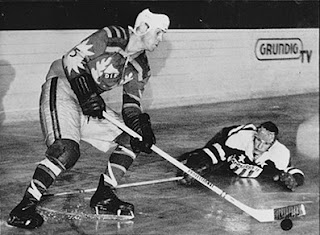
Was there anything this man could not do?
A legend of Swedish hockey, Sven Tumba had a chance to become the first European star in the NHL (I don't count the Slovakian-born, Canadian-raised Stan Mikita), but it wasn't to be. Consequently, most North American hockey fans have never even heard of him. But as I said, over in Europe, particularly his home country, this guy was a big deal. You're about to learn why.

Born with the extremely common Swedish last name Johansson, he would eventually legally change it to Tumba - the name of the small town he'd grown up in -  and by all accounts, he earned it. He played sixteen years - from 1950 through 1966 - with the Tre Konor, Sweden's national team, and established himself as their best player, eventually becoming captain. He won seven medals at the World Championships (three gold, a silver and three bronze), two Olympic medals (bronze in 1952 and silver in 1964) and retired having scored the most goals ever for Team Sweden with 186 in 245 games. Within the Swedish League he led his team to eight national championships. Yeah, the guy was a winner.

And it doesn't stop there. He was multi-sport athlete, playing soccer at the professional and international levels and was a pro golfer too. In fact, he's responsible for introducing golf to the Soviet Union. Oh, and he was also a Swedish water-skiing champion. Besides that he also hosted his own radio show called The Tumba Hour and founded multiple charitable organizations as well as inventing the Scandinavian Open and running his own hockey school. And who was it that actually invented the hockey helmet? It was SVEN FUCKING TUMBA.

So he was a great player on the international amateur scene, but was he good enough to have played in hockey's greatest league? Hell yeah. Tumba was actually the first European to ever attend an NHL training camp when he tried out for the Bruins in the late fifties. They offered him a $50 000 contract (quite a bit back then) to start with the Quebec Aces, who were the Bruins's farm team at the time, but he ultimately turned it down because playing pro in North America would have made him ineligible to play for his beloved Swedish national team.

But an interesting fact I dug up is that while he was there (1957) he did play a handful of games with the Aces who at the time had a twenty-one year old Willie O'Ree on the roster. If the name doesn't ring a bell, O'Ree was the first black player to ever play in the NHL, having played two games as callup for the Bruins that season and then forty-three games with them in the 60/61 season. I think that's pretty interesting and it's weird that I've never read about it anywhere.

Although he was a centre, Tumba was more of a goalscorer than playmaker and a signature move of his was taking the puck off the boards in the offensive zone and deftly cutting into the middle to unleash a wicked wrist shot. Actually, one thing he took home with him from his experience in North America was the slapshot - something that really wasn't being used over in Europe at that time. Reportedly he was so good at it that some folks called for it to be banned because I guess they thought it wasn't fair to the poor goalies. Well, we all know that eventually the slapshot did catch on across the sea and it seems only fitting that it was Sven Tumba who'd shown them the way.

Tumba passed away last year and the nation of Sweden mourned the loss of a hero, who many still feel was the greatest of their country to ever play the game. Considering some of the Swedish stars we're all aware of who play or have played in the NHL, that's high praise indeed. I really feel that in the late fifties and early sixties he could have been a star player for the Bruins, maybe even helping them to not completely suck as they did back then. We can dream.

2. Valeri Kharlamov LW
Our first taste of dazzling Russian skill
One of the rare players elected to the Hockey Hall of Fame never to have played in the NHL, there is really no doubt he would have been a star there. Other entries on this list can certainly be disagreed with but not this one. Kharlamov is pretty much a slam dunk.

I could have made all my picks Russian players who played and retired before the fall of the Iron Curtain. Hell, I could have made this list entirely out of Russians who played in the 1972 Summit Series that made Kharlamov so famous. But better to have some variety so I opted to just pick one. It was a no-brainer to go with #17 as he's probably the most electrifying non-NHL talent ever to be seen by North American fans.

He made an immediate impact too. In the infamous first game of that series in Montreal, wherein a team of NHL stars were shellacked by a team of Russian "amateurs" by a score of 7-3, no Soviet player stood out more than Kharlamov. He was just twenty-four years old but he amazed with his skills, scoring two goals and was named the game's best player.

Throughout the series many Soviet players distinguished themselves, proving that they were certainly good enough to play in the world's best league. It's a story every Canadian should know by heart but if you don't then I urge you to at least look it up online and to find the games to watch sometime too. It's a huge part of hockey history.

So there were a lot of revelations during that series but the one I'm focusing on here is that Kharlamov impressed everyone involved with Team Canada and they would speak glowingly of his ability and tenacity (he was the most penalized Russian player in the series). I've seen the games myself and although he was a smaller player (5'8, around 170 pounds) he was in no way hampered against Canada's physical play (well, until Bobby Clarke broke his ankle with a slash). There is no doubt in my mind that every single player on that Soviet team was at least good enough to be an NHL regular and that a handful of them would have been absolute stars. Kharlamov is the cream of that crop and I envision him as an NHLer with multiple fifty-goal, hundred point seasons during his heyday in the seventies.

Like many of his teammates, his international stats are spectacular and he always acquitted himself well at the Olympics (three appearances) and World Championships (eleven appearances). Tragically, his career and life were cut short when he died in a car accident at the age of thirty-three in 1981.

To this day, many Russian players with offensive flair wear his number 17 the way Canadians wear numbers 9 and 19. It truly is a shame that politics kept him from hockey's greatest stage (recall that in his day the Olympics did not involve professional players) because he truly was one of the all-time greats.


1. Tony Hand LW RW
He coulda been a Cape Breton Oiler!
Hand takes the top spot not because he is the player whom I'm most sure would have been an NHL star but because I find him to be the most interesting. Of all the NHL careers that never were that I've read of, none make me ask "what if?" more than Tony Hand's story.

Born in Edinburgh, Scotland, he established himself as a phenom early on, playing for the Murrayfield Racers at the age of fourteen. Now I know what you're doing to say - so what? He was a phenom playing hockey over in freaking Scotland?! What the hell does that prove? Well, to that I say: read on. First of all, the Racers may have been a Scottish team but they weren't a junior team - Hand found himself playing against grown men from his mid-teens on. And the players weren't all Scottish - there was even a smattering of displaced Canadians. Granted, these were Canadians who obviously weren't good enough to play in most of the respected pro leagues but still.

He became a regular member of the roster for the 83/84 season at the age of sixteen and led his team with 52 goals and 95 points in just thirty games. In the next two seasons he would rack up over seventy goals and 164 points each time, in just over thirty games. Inferior league or not, the kid was averaging over five points a game playing against players in their twenties and thirties. In early 1986, he was the winner of the Young Player of the Year award and the prize was to attend the Calgary Flames training camp that summer.

At the start of that summer, a curious thing happened. News of his scoring exploits had somehow reached NHL scouts and he was drafted with the final pick -  that's 252nd overall - of the 86 draft by the Edmonton Oilers. So it was their training camp he found himself attending. He acquitted himself well there, lasting the entire two weeks without being cut. He impressed Oilers coach Glen Sather with his skills and vision. In fact, it was his opinion that the teenager possessed more on-ice intelligence than any of the other players there, with the exception of Wayne Gretzky, the Great One himself. Remember, not only was this an NHL team but the mighty Edmonton Oilers, one of the best teams ever assembled - just think about some of the players on that roster. Sather said that Hand was "a real prospect".

He would play in three games of Canadian major-junior with the WHL's Victoria Cougars, scoring four goals and eight points. But homesickness, coupled with the exhaustion from being such a target of the media, caused him to return home. That season with his home club, he exploded for 105 goals and 111 assists for 216 points - his first of four two hundred point seasons. He helped Canadian teammate Rick Fera score an astonishing 133 goals to lead the league in scoring. Fera had played Canadian major junior a few years prior with the Sault Ste. Marie Greyhounds. His teammates included future NHLers Rick Tocchet and Jeff Beaukeboom.

Another interesting fact about that season is that while Hand was third in league scoring with his linemate Fera taking the first spot, second belonged to a thirty-eight year old Gary Unger - veteran of over a thousand NHL games with nine thirty-goal seasons to his credit. I think this helps us gauge the level of talent Hand had - Unger may have been past his prime but he was still a genuine NHL player and an above average one at that, as his stats attest - he was still good enough to rack up a league-leading 143 assists along with 95 goals in the Scottish league. And Hand - still just nineteen at the time - was right up there with him.

The following summer he would return to Canada to train with the Cougars and he was offered a contract to play for Edmonton's farm team in Nova Scotia - but he turned it down, figuring he could make more money back home. Years later, he would reflect that perhaps he'd made a mistake and that he should have renegotiated the offer and given playing pro hockey in North America a real try. Sather -  a man who certainly knew something about hockey talent - believed he really could have progressed playing against better competition and I have to agree.

So for the next two decades Hand would continue to play for teams in Scotland, putting up astronomical stats well into his thirties. In his final season with the Racers, 93/94,  he would have his best statistical season with 72 goals and 150 assists for 222 points in only forty-four games.

In 2001 he became a player-coach - a role he continues to play to this day in his forties. I urge you to look him up to get all the details of his incredible career.

But it's the career that might have been that I think about the most. Could he have made it to the NHL? Could he have flourished there? Considering his skills and intelligence, I have to believe he could. He was modest 5'10, 185 pounds - roughly the size of a player like Dale Hawerchuck - but he played a fairly physical brand of hockey. Certainly playing in any league in North America would have been an adjustment but he seemed to have no problem with the OHL, even if it was only a very brief stint.

The NHL still awaits its first Scottish born and raised superstar. Maybe someday.