Showing posts with label Comics. Show all posts

Sunday, January 31, 2016

Moon Knight's Most Badass Moments (so far)

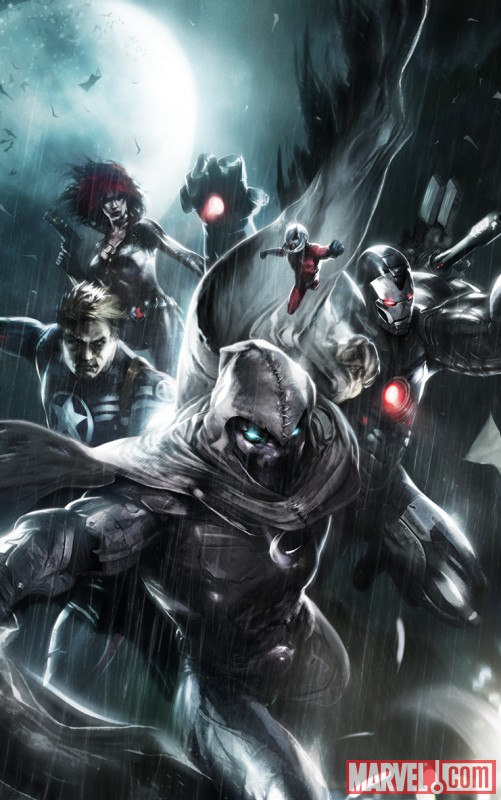
For those of you who haven't been paying attention or just really suck at remembering stuff, my favourite comic book character (also: I'm the one who's into comic books) is Moon Knight. And for those of you who aren't me or like twelve other specific people, Moon Knight is a "superhero" in the Marvel Universe.

He looks like this:


While it's hardly a unique trait among comic book characters, particularly superhero types, one of the major things that makes Moony my main man is that he's a total badass. He's a maverick who plays by his own rules and when he's not being outright ignored by the superhero community at large, he's being actively shunned by them. Even Deadpool winds up doing more team-ups than him. This also makes him something of an underdog - he doesn't really have any powers and when he's in trouble he (usually) doesn't have the option of calling up Tony Stark or Nick Fury.

Now before I launch into an essay on all the stuff that makes Moon Knight my avenging spectre (ha) of choice let's return to the main point which is he's badass. With that said, here is a sampling of some of his most badass moments.

Spidey didn't like posing for this one
Honourable Mention: Ultimate Moon Knight crazies himself back to life (Ultimate Spider-Man #110)
Haven't done the honourable mention thing in a while because I don't want to somehow undermine the five choices I make, but I thought that since this isn't the regular 616 version of Moon Knight, I could get away with it.

Moon Knight only appears in a couple of arcs of Ultimate Spider-Man but writer Brian Michael Bendis definitely does him justice. I think that's partly because he's really not very different from his classic incarnation. He's still former mercenary Marc Spector, now wealthy and sometimes moonlighting (I had to) as a New York cabbie who also dresses in the aspect of Egyptian god Khonshu and fights crime. The costume is given a bit of a tweak (as you can see) but his methods, personality(ies) and genuine craziness are all pretty much intact, although the personalities are shuffled a bit.

Our moment occurs in the second arc containing Moon Knight, "Ultimate Knights", a nod to the Marvel Knights comics in 616. Moon Knight first met Spider-Man in the arc "Warriors". The two fought for awhile and Moony succeeded in totally freaking Spider-Man out. Here, Moon Knight teams up with him, Shang-Chi, Daredevil, Iron Fist and Dr. Strange in an effort to take down the Kingpin, who is pretty much EXACTLY the same as his 616 counterpart. Shang-Chi had previously attempted to infiltrate Fisk's organization via posing as a skilled assassin for hire (actually to replace Elektra who had been killed by...Moon Knight) but his cover was blown rather quickly and he barely escaped alive. The group decides this was still a good idea, and, as part of their larger plan, should be attempted again. Moon Knight volunteers to be the one to do it and everyone agrees at once since Fisk isn't that familiar with him (as he was with Shang Chi and is with DD and Spidey).

Ultimate Ronin
It goes quite well at first as Moon Knight creates the character of Ronin (a nice nod to something concurrently going on in New Avengers, also written by Bendis) and is quickly hired. Of course it still winds up a disaster as ruthless assassin Ronin eventually asserts its dominance over all of Moony's personalities and he goes from undercover agent to full on baddy. The situation in his head is actually visually illustrated for us as we see the personalities all meeting and discussing the situation together. But in addition to Steven Grant (who is now the cabbie - there is no Jake Lockley), Marc Spector (businessman) and Moon Knight, Ultimate Moony also has a nameless little girl personality. She's also eyeless. Because that's cool. Ronin murders Moon Knight, drives off the others and takes over. Spider-Man actually has to fight Ronin after the latter is ordered by Kingpin to apprehend him and is quickly defeated. But taking out the hero in his own book isn't Moony's badass moment here. No, that comes when he finally is discovered by Fisk (ok, actually Kingpin had known all along but the last thing this entry needs is more explanations) and is promptly executed by two mooks. Shot in the head and dumped in the outskirts to send a message to other costumed vigilantes in New York.

Except Moon Knight eventually gets back up. How did he pull this off? No healing factor, no illusion powers, nothing like that. Back in his messed up mind, we see the other personalities urging the seemingly dead Moon Knight persona to wake up. The little girl screams at him a bit to no avail. Then Ronin comes over and gives a try, grabbing his head and yelling "Get up!" It does the trick.  The personality revives and so does his physical self. He staggers to a police station, takes off his mask and has Fisk formally charged with attempted murder leading to his arrest (something none of Spidey and the others could achieve).

So there you have it: Moon Knight is actually too crazy to be killed. Badass.


5. Burning His Ties To The Avengers - Literally (Marc Spector: Moon Knight #50 Volume 3)
Yeah, screw those guys
While the Marc Spector: Moon Knight series was the longest running, it really wasn't one of the more memorable runs for the character. The creative team was always in flux, causing the tone and direction to fluctuate along with it. Sure, some cool and important stuff happened like Punisher killing Marc's insane brother Randall (something he thought he'd done himself years previously), visiting a couple of alternate universes and participating in Acts of Vengeance hijinks, but as a whole it was kinda weak.

Still, one of Moony's most badass moments does indeed happen in this series. I'm not entirely certain of the order of events but I'm reasonably sure that at the time of the series's opening, Moon Knight was a member of the West Coast Avengers. He (along with Tigra and Mockingbird) leaves the team in issue #41 but it's established at some point later on in Marc Spector Moon Knight that he's still considered a reserve member and thus has a membership card. So-called misuse of said card was one of the actions that led to Moon Knight's fiery resignation from Earth's Mightiest Heroes.

The Avengers, in disarray after the events of Operation Galactic Storm and Captain America's subsequent resignation as team leader, became increasingly concerned with Moon Knight's actions, particularly using his membership card to gain access to the Latverian consulate and attack Doctor Doom (an extremely badass act in itself), his ties to the Punisher as well as villain Tombstone and the revelation (captured on television no less) that he'd been housing some kind of demonic presence in his body - Demogoblin by way of Hobgoblin. Anyway, Moon Knight, busy with his own affairs, repeatedly ignores the team's calls insisting he come in for a meeting.

 Finally, he agrees to go after an altercation with Thor. They spend so much time debating the pros and cons of having him on the team as well as whether or not his actions require some sort of disciplinary measures on their part, that he up and leaves while they're babbling. They don't even notice until seeing the smoke from the flaming membership card he leaves behind.

4. The Raid, Superhero Style (Moon Knight #5, Volume 7)
I'm assuming the elevator wasn't working
This one doesn't require much setup. In the latest Moon Knight series, kicked off by writer Warren Ellis, standalone stories limited to single issues replaced the common practice of story arcs spanning multiple comics. After six great stories Ellis moved on but later writers mostly followed his example. In this particular issue, the second last written by Ellis, Moon Knight storms a dilapidated apartment complex to rescue a kidnapped young girl.

In what is a clear homage to awesome action movie The Raid, (director Gareth Evans's name can be seen spray painted on a wall in one of the panels), Moony makes his way from the ground floor to the sixth, cutting a brutal and bloody swath through all resistance.  His nasty fighting style has been showcased in many issues over the years but perhaps this is the single one that celebrates it the most. I'd point out some of the highlights except: 1. Pretty much every panel is a highlight 2. I really couldn't do them proper justice. So just seek out the comic for yourself, in print or digitally.


Moony with a sidekick?
3. The Final Moon Knight/Midnight Reunion (Moon Knight #12, Volume 4)
One thing Charlie Huston firmly re-established in the Moon Knight mythos is that for someone without any powers, the guy can take a hell of a lot of punishment. This is illustrated in spades in the two Huston story arcs "The Bottom" and "Midnight Sun". The next badass moment comes from the latter.

Way back in the very first Moon Knight series, our hero came up against a flamboyant art thief called The Midnight Man. Despite his initial seeming lack of a threat, he would quickly become something of a nemesis for Moony, culminating in his going insane after having his face disfigured from a fall in one of their encounters. He went from daring cat burglar with a thing for theatrics and mind games to another damaged opponent, bent on revenge. Then he died.

Years later, during the Marc Spector: Moon Knight run, Marc would be faced with a new chapter in the saga between himself and Anton Mogart (Midnight Man's real name): a young man named Jeff Wilde, who claimed to be Mogart's son. But this wasn't the old "son of a vanquished villain shows up for revenge" schtick; Jeff wanted to help Moon Knight. His reasons were never all that clear. He said something like he wanted to make up for all the trouble his father had caused Marc but by offering his services as costumed sidekick Midnight, he just caused trouble of his own.

Still, Moony reluctantly agreed to take him on, feeling somewhat responsible for what happened to the kid. But Jeff, while not entirely without guts and talent, wasn't very effective as a crimefighter and more often than not blatantly disregarded Moon Knight's advice and orders. Eventually his bumbling got him captured by the lunatics at the Secret Empire (an offshoot of Hydra considered too crazy even by their standards) and they did the logical thing: turned him into a superpowered, killer cyborg. Sometime later, he apparently died.

But years after that, Huston revealed in "Midnight Sun" that Midnight was still alive and had become completely unhinged and completely obsessed with having a showdown with his former mentor. To get his attention he went about murdering people and ripping their limbs off to use them as hands in clocks traced in blood. The hands pointed to midnight.
"I knew I could save you, Jeff."

Moon Knight tracked him to a makeshift lair in the sewers (much like one Mogart fashioned years before) and was promptly overwhelmed when attempting to ambush Wilde. With the aid of a female cyborg assistant, who apparently had nursing skills, Midnight (now dressed in his own Moon Knight costume) tortures the bound (to a giant clock face) Moon Knight by removing parts of his spine with a pair of pliers. Yup.

So this goes on for a few minutes until lady cyborg gets upset, clobbers Midnight and frees Moony, who is, you know, not in the best of shape. She whines to him for a bit about how she and Midnight are unable to die and how Midnight had assured her Moon Knight would be the one to "save them". She expresses her disappointment in him. Moon Knight, having somewhat regained his wits says "I can save you." He rips the minute hand off the clock and leaping off the platform, plunges it down Midnight's throat, ending the latter's torment. A pretty emphatic form of closure on the whole Midnight Man/Midnight saga.

(That was the badass moment but if you're wondering about loose ends, I'll just inform you Moon Knight also "saved" the woman by telling her walk out of the tunnel and gaze at the full moon for her salvation. In doing this, she is blown away by the heavy ordinance of Moony's helicopter.)
Moon Knight: Secret Avenger
2. Making Deadpool Say Uncle (Vengeance of the Moon Knight #8, Volume 5)
Charlie Huston's resurrection of Moon Knight in 2006 (his first ongoing series since the mid nineties) was what absolutely solidified his status as my all-time favourite not only superhero but comic book character, period. As with Ellis nearly a decade later, Huston kicked off the series but only stayed on for about a third of its run. He wrote two amazing arcs (named in the previous entry) then writing duties were taken over by others. While I enjoyed seeing an overmatched Moony take on the Thunderbolts after Norman Osborn (head of H.A.M.M.E.R. at that time) sicced them on him, the final arc of that series, "Down South", with a mostly out of costume Moon Knight fighting cartels in Mexico, was a big letdown for me.

This was immediately followed by a new series, Vengeance of the Moon Knight (Volume 5), that had a somewhat new direction: Moon Knight trying to be a bit more "heroic" (this being The Heroic Age of Marvel at the time) and erase some of the ill will he'd built up in the superhero community and public eye. So he's basically making a concerted effort to not, you know, kill or horribly maim his opponents or cause too much collateral damage. He does so well in this he impresses Steve Rogers enough to recruit him to a new Avengers team, albeit a secret one (um, Secret Avengers) that no one outside of it will be aware of. A pretty big turnaround after Rogers's "I don't like your style, mister," speech to Marc Spector back during Huston's run.

Anyway I'm mentioning all this to properly set up the next badass moment. Sure, Moon Knight has been playing by the rules and even playing well with others - things he's definitely not known for - all to very encouraging results. But he's still Moon Knight and operating this way was...kind of getting to him.

Enter The Merc With a Mouth, Deadpool.
You shouldn't have mentioned the healing factor, Wade

Deadpool was doing what he does - he was on the job to assassinate some crime boss for a woman whose life had been destroyed by said crime boss - when Moon Knight arrived and stopped him. Said crime boss was confined to a hospital bed at the time and of course, the new "good boy" Moon Knight couldn't allow him to be murdered while helpless. Deadpool of course taunts him for this as they fight (Moony didn't know who the heck it was and would later refer to him as "that welfare-looking Spider-Man) and asks: "Come on Casper, where's that killer instinct?" Moon Knight tells him he's about to see it but Deadpool is incredulous: "Sure. You're Lee fucking Marvin with me - who can't be killed."

Well. He shouldn't have said that. Moony draws a sword (OF COURSE he has a sword) and declares: "Game on." Deadpool answers with his own blade but now that Moony isn't holding back anymore, it's really no contest. He proceeds to slice and dice the annoying mercenary until there's not a whole lot left to cut. He dispatches one of the most badass characters in the Marvel U with ease. Deadpool concedes defeat with a: "*Kkkkkkkkk* Uncle*" and Moon Knight stalks off remarking how he really needed that. And so did we.


1. Another Faceoff With Bushman Ends In A Face...Off (Moon Knight #2 Volume 4)
Well, it really was a face only a mother could love
As this list has already demonstrated, acts of horrific violence are pretty routine for Moon Knight. And while I hope I've shown that he still has badass moments that don't directly involve them, you shouldn't be all that surprised that our number one entry is yet another. And this one tops them all.

Moon Knight #1 of the 2006 series ends with a broken and disheveled Marc Spector. We're shown he's been out of the hero game for quite awhile and that his life has subsequently fallen apart, lashing out and alienating the small handful of people in the world that actually care about him. We see him sporting a beard while sitting in a chair yelling at his Khonshu statue. It appears he doesn't even have his faith anymore. Not in his god and not in himself.

Moon Knight #2 gives us the flashback that shows how he arrived in such a state. Fittingly, it's a battle with his arch nemesis, the man who inadvertently created Moon Knight, the vicious Raoul Bushman. The two are slugging it out on a rooftop. Moony provides some great running commentary as they go at each other:

How many times before a guy figures it out? How many times do you beat a guy down? How many times do you take him out? Before he knows you're better than he is? He never got it. Guess that's why he's called a nemesis. So, how many times can you do the same thing? Before you get sloppy? Blame it on arrogance. Blame it on a bag of tricks grown tired. Blame it on the passing years. Blame it on him. Blame it on our hatred. The hatred born from slaughter. Slaughter born from friendship. Friendship born from recognition. Recognition of a kindred soul. Souls hating each other. Hating as you can hate only one thing. The reflection in the mirror.

Oh, this can't be good

You won't see Batman doing that
Eventually the fight goes over the side of the roof and Moon Knight is badly injured, hitting his legs off a fire escape on the way down. Lying sprawled and broken in the alley, he's nearly defenceless as Bushman, staggering through a barrage of crescent moon darts and collapsing at his side, manages to bite his enemy's face right through the mask with those terrible filed teeth. Moon Knight somehow manages one final punch then grips Bushman's face in one hand while retrieving one more crescent dart with the other.

Then he peels off the guy's face.

I think it's only too appropriate that Moon Knight's most badass moment ever is also the one which led directly to a downward spiral which nearly destroyed him physically, mentally and spiritually. After two years on the sidelines, wallowing in self pity and abusing pain killers, he managed to pick himself up once again (with a little help from his friends, of course). He's a character who has died and been resurrected several times in continuity, but it's this resurrection of his life, pulled off not by an ancient Egyptian god but by the man himself, that is his greatest comeback.


Sunday, November 1, 2015

Cole's Favourite Transformers

When I was a kid, I watched lots of the popular cartoons of the day ("the day" being the mid eighties through mid nineties, mostly). Some of those even included shows geared towards girls, like the original My Little Pony (more because of its timeslot than anything else, I think, although I'm not trying to make excuses here) and Jem (which I genuinely enjoyed for some reason). But still, being a boy, it was stuff like He-Man (and, yes, She-Ra), GI JOE, M.A.S.K. and Voltron (which became my favourite when I was much older) that I liked the most. Hell, even more forgettable stuff like Bravestarr was alright by me.

But one show stood above them all. This was the show that I followed as closely as I could and collected as many of its toys as my parents would buy for me. Since the entire purpose of this show was to get kids to buy their toy line, in my case I would say mission accomplished and then some. This show of course was The Transformers. Even though some episodes and characters were totally phoned in and stupid, and there were animation errors aplenty (more than any other cartoon I can think of) I'd contend that actually the vast majority of the content was really good. I mean, as this was a show created simply to advertise a toy line, it would be understandable if it was all halfassed, forgettable crap. But I believe its creators really put a lot of effort into the animation, characters and stories. It's amazing how well much of it still holds up even all these years later.

Because the series's main mandate was to sell toys, TONS of characters were introduced. Of all the shows I watched as a kid, Transformers easily had the biggest cast. And as I've said, this definitely led to a quantity-over-quality approach. With so many characters, good guys and bad guys, vying for screentime, many of them were one-dimensional and lame, with their only redeeming quality being perhaps their transformed mode.

This also led to a lot of annoying voices since, with such limited time to develop characters, the easiest way to differentiate between them was making their voices and/or way of speaking somehow stand out from everyone else. This gave us results such as THREE characters who spoke in rhyme (Jazz thankfully only briefly, Blaster occasionally and Wheelie ALL THE GODDAMN TIME),  the tank, Warpath, endlessly punctuating his sentences with exclamations of "Bang!", "Zoom!" and crap like that, some weird accents (Tracks, Outback, and someone who appears on this list) and miscellaneous weirdness like the Dinobots (speaking like braindead retards), Blurr (talking like a superfast retard) and Seaspray (gurgling?).

There were some great characters, though. And, of course, Transformers exists in all kinds of media besides the show, like comics, movies as well as tons of different updates of the show. So plenty of characters were given more dimension there. All are in different continuities and sometimes make changes to various characters. For this list I'm considering characters based on ALL their appearances. Let's get to it.

5. Razorclaw (Transformed mode: Lion)
While hardly a major character in any incarnation of Transformers, Razorclaw is still the leader of the Predacons unit, and that has to count for something. Actually, in the IDW Comics continuity, the Predacons are considered one of the most elite units in the entire Deception force. And, typical of being a Predacon I guess, in most media he's shown to be one of the most capable fighters when it comes to hand to hand combat.

He's proven himself a good leader as well, with a sort of all-business attitude that's actually kind of unique among Decepticons. I guess I like him because the Predacons are my favourite Combiners in all of Transformers and, as their leader, he's their best representative. He transforms into a lion and is often able to overwhelm opponents in this mode. When in robot form he wields a really cool sword (officially called a sonic sword as it's able to emit powerful vibrations) and you know I love swords. Not many transformers, Autobot or Decepticon, have swords so this makes him unique as well. An effective tracker as well as commander, it breaks my heart I never had his toy.

Personal Crowning Moment of Awesome: I'd go with the episode "Nightmare Planet" from the original animated series. Specifically when he's forced to team up with Autobot, Springer in battling his way out of a castle created by Daniel Witwicky's dreams (yeah, it's a weird one).  The castle is owned by a fearsome dragon and Springer, wielding some kind of trident, rode Razorclaw (in lion mode, obviously) and they charged the dragon, managing to kill it. Serving as horsey for the enemy may seem like an odd pick but trust me, it's really cool.


4. Galvatron (Transformed mode: Laser cannon)
Well, I think you'd all agree that this guy definitely is a major character. Some people might've even doubled down, taking the old Megatron/Galvatron route, fitting in two characters
for the price of one. They'd certainly be justified in doing so. But to me, Megatron and Galvatron are separate characters and should be treated as such. While in most continuities, most notably the original show, he was formerly Megatron, he wasn't in all of them. In the IDW comics, for instance, he is a completely separate character who actually predated Megatron by millions of years. And even if you are dealing with a continuity where he isn't, I still believe the change (or, transformation, if you'll allow me) was enough that there's really nothing tying him to Megatron anymore besides a fanatical desire to defeat the Autobots.

If this list was a few slots longer I would definitely include Megatron because he is awesome and probably one of the best villains you can find. He's extremely powerful, brutal, charismatic and, even though it's true he kind of loses all the time (such is the fate of the villain), actually quite a competent leader. He's even shown to be quite rational, sometimes putting aside his hatred of the Autobots for the sake of the greater good (although in those cases the greater good only counts because it involves saving his own skin and that of his Decepticons). It seems every time he dies he manages to come back and just his name strikes fear into the hearts (or...circuits, I guess) of Autobots and those on the side of good.

So why am I picking Galvatron over him? For starters, one key difference between him and Megatron is that he (Galvatron) is most definitely NOT rational. While Megatron could certainly became enraged and occasionally fly off the handle, this is basically the permanent setting for Galvatron. He's always screaming and ranting and raving, threatening everyone around him. While that could just as easily be an argument for why he isn't as cool as Megs, personally, it just really appeals to me. Galvatron is a fucking lunatic and I love him for it. It makes him wildly unpredictable and ridiculously dangerous. In the continuity of the Generation One cartoon, it's his defeat at the hands of Rodimus Prime (The Transformers The Movie) that really drives him over the edge. Things get kind of confusing after that because in both this continuity (as continued in the Transformers Headmasters series that never aired in North America) as well as the Marvel Comics continuity, there are diverging timeliness involving his path, so multiple versions of him result.

In the world of IDW comics, Galvatron hails from Cybertron's fabled (and oft-referenced) Golden Age, which predates that continuity's setting by a few million years. That's before there were such things as Autobots and Decepticons and he was actually close friends with that era's Prime, Nova Prime. Here he's part of a spaceship crew (the first Ark) that is lost in an anomaly sending them into what's known as the Dead Universe, where he became an undead being. I don't think I'm spoiling anything by saying that he eventually shows up in the present to trouble the Autobots.

In most continuities he's presented as even more powerful than Megatron, which is really saying something. Hell, in some he's nigh invincible. I love the purple colour scheme (purple seems to always work so well as the colour of evil in various things for some reason) too.

Personal Crowning Moment of Awesome: For a guy like him, there are many but it's tough to beat his arrival on Char just after his rebirth at the hands of Unicron (The Transformers The Movie). The devastated Decepticons have reluctantly allowed Starscream to assume leadership in the wake of Megatron's demise when suddenly Galvatron touches down with the also newly created Cyclonus.

Starscream: Who disrupts my coronation?
Galvatron: Coronation, Starscream? This is bad comedy.
Starscream: Megatron? Is that you?!?!
Galvatron: Here's a hint! (Transforms into cannon mode and blasts Starscream to ashes)

It's so awesome you should see it. So here you go.


3. Sky Lynx (Transformed mode: It's...complicated)
Here we have a truly unique transformer. This guy doesn't even have a robot mode. Instead Sky Lynx is a sort of triple-changer who actually has FOUR (just three in the Marvel comics though) unique forms, those being: lynx, space bird (?), space shuttle and...space bird with lynx legs? I don't know. But it doesn't matter because he's awesome. And he knows it too. In fact, he repeatedly lets everyone around him know just how awesome he is. Just how full of himself is he? Well, consider this quote from the Generation One show: "Before you do anything, think, 'Is this what Sky Lynx would do in my position?' , and you will not go far wrong." ("Call of the Primitives").

Holding the rank of Lieutenant Commander, which maybe isn't all that impressive because Grimlock does too, I'll always associate Sky Lynx with my memory of the commercial for his toy (which also featured the Predacons/Predaking, something we'll explore in further detail below) which used footage from the show as well as catchy musical hook ("It's Sky Lynx!). I actually had this commercial on tape, as it appeared during an episode of Ducktales, another great cartoon from that era.

By Season Three of the Generation One show, Omega Supreme was still around but Sky Lynx seemed to take over as the Autobots's de facto mode of transportation when going on missions deep in space and/or to other planets. And, unlike the Decepticon equivalent for this, the triple-changer Astrotrain, he actually retained his giant size. Strangely enough, while in his own shuttle mode, Astrotrain is large enough to transport many of his fellow Decepticons (a good example is in the movie right after the battle at Metroplex where Starscream tosses out the nearly-dead Megatron) but as a robot, is the same size as the average transformer. The two have actually battled each other several times. But, as the aforementioned commercial suggests, it's the Predacons Sky Lynx has a real rivalry with, clashing with them on numerous occasions. In the Generation One episode, "Call of the Primitives", where he is front and centre, it must have really galled him to be lumped into the same group as the Predacons as well as the Dinobots and the various animal cassettes. In that instance he immediately named himself leader of that group. Also to his shame, during the show he was often mistakenly animated with a Decepticon insignia. How insulting!

Personal Crowning Moment of Awesome: While his rescue of the Aerialbots (as Superion) in the episode "The Big Broadcast of 2006" (a favourite of mine) deserves a mention, I'd say it was his role in locating and bringing back a Quintesson during the Hate Plague ("The Return of Optimus Prime parts 1 & 2"). Fortunately one of the few Autobots not infected by the plague was the magnificent Sky Lynx as he was the only one left capable of spaceflight. The Quintesson he retrieves is successful in restoring Optimus Prime to life and Prime discovers how to stop the plague. Sky Lynx then helps Optimus against Galvatron and although he later does wind up being infected by Rodimus, his prior actions led to the curing of the plague.


2. Optimus Prime (Transformed mode: varying kinds of 18 wheeler truck)
Like on some of my other lists, we've come to an entry on a character who is so iconic and so celebrated that I'm at a loss for what to say about him. There have been many, many different incarnations of the Transformers over different forms of media. And while some can get pretty different and "out there" when compared to the original show and Marvel comic, the leader of the Autobots, Optimus Prime, is always present. Although his character doesn't exactly appear in the Japanese animated series Super God Masterforce, his form does at the least (Ginrai) and as far as I can tell, that's really the lone exception.

Naturally it's his depiction in the Generation One cartoon that still stands as probably the most iconic and it's the one I draw the most from with the current ongoing IDW comic series coming in second. I mean, honestly, how could he have had the same initial impact without the brilliant voice talent of the legendary Peter Cullen? Even Michael Bay and the geniuses behind the live-action film series realized that there was no way they'd succeed if they didn't get the man himself to once again voice Prime. And  while you can say what you want about those movies, back in 2007 when I saw the first one, hearing Cullen's voice in the theatre literally sent shivers down my spine.

Optimus is leader of the Autobots but he's not the type to lead from the back. Whatever's going on, he's in the thick of the action. And while it's true that many characters on the original show were often poorly written and forgettable, Optimus was ALWAYS well-written, exuding courage, strength, wisdom and compassion that often transcended the cartoon. As weird as it sounds, this giant transforming alien robot warrior was actually a good role model for the children who watched the show. He always showed reluctance to battle the Decepticons and often expressed his disappointment and frustration with constantly being forced to fight. He lamented that Megatron and the Decepticons couldn't learn that their way of attempting to conquer everything around them by force was wrong, that it was anything but glorious. But when it came time to fight, he was ready.

And really, there was no one better at it. As I said, Optimus was an incredibly "hands on" leader. He wasn't just a brilliant commander and tactician but was unequaled in battle prowess. Whether he was firing away with his ion blaster laser rifle, fighting hand to hand or even in vehicle form, he was a force to be reckoned with, able to defeat many enemies single-handedly, best Megatron one on one and even fight off much larger opponents. The Decepticons knew to fear him and few would dare engage him without plenty of support.

Probably the best depiction of Optimus becoming a Prime is the IDW comic miniseries Transformers: Autocracy. Set on Cybertron just before the Great War (the beginning of the millions of years of Autobots vs Decepticons conflict), Autobot commander (of what was a special police unit back then) Orion Pax is given the task of rooting out terrorist Decepticon cells sowing dissent throughout the city-state of Kaon. The Prime at that time was Sentinel Prime.

As noted above, some version of Optimus Prime exists in every incarnation of Transformers and while they have their differences, all are great leaders. Still, Peter Cullen, much like Kevin Conroy with Batman, gives the definitive vocal performance and his is the voice I hear in my head whenever I read any of the comics.

Personal Crowning Moment of Awesome: Too many to mention, obviously. He had one in nearly every episode of the original show and plenty more were to follow in other shows, comics and movies. He even has some great ones in the much-maligned live action films. Personally, I love his highway battle with Bonecrusher in the 2007 movie. Even his death scene in the animated movie could be considered one. But for me, it's not a moment of glorious combat or even that dramatic a moment that always resonates the most. I'm going to give it a pretty long setup because I think that's the only way to give it proper justice so bear with me.

In the Generation One cartoon, there's an episode called "The Core" wherein Megatron has the Decepticons construct a massive drill to tap into the earth's molten core. The plan is to harvest geothermal energy thus giving themselves either an alternative to Energon or possibly an ingredient to make it; it's never explicitly stated.

The plan, as pointed out by Starscream, is incredibly risky as the deeper they drill, the greater the chance of breaching the core and causing the earth to explode. Megatron brushes this off, saying he has a contingency plan in place: a space bridge capable of teleporting the Decepticons to Cybertron is nearby in the event of the drill threatening the earth's stability. The Constructicons build and operate the drill.

As you would expect, the Autobots discover this plan and try to stop the Decepticons. To counter the power of Devastator, whom they know Megatron would surely deploy against them, Wheeljack and Chip (Spike's wheelchair-bound friend) created "dominator discs" - small discs that need to be placed on each individual Constructicon. Once this is accomplished, when they combine to form Devastator, the discs will activate and allow the Autobots to take control of Devastator.

Blah, blah, blah. They get the discs on the Constructicons, predictably the drill goes haywire and the earth is in danger, the space bridge becomes damaged so now the Decepticons are in the same boat and Megatron agrees to work with the Autobots to save the planet. Devastator, who had briefly been under Autobot control as planned but isn't anymore, uses his strength to destroy the drill. But when he returns he finds Megatron and the other Decepticons have fled. Chip tells him his "noble leader" ran to save his own hide but Devastator, loyal to a fault, states he left to plan his next attack, as a good leader would. He takes off and Chip sighs. He says he was hoping that Devastator/The Constructicons really would join the Autobots but dismisses it as a "dumb old dream." As the music dramatically comes up, Optimus comforts Chip with these words: "Hang onto your dreams, chip. For the future is built on dreams. Hang on."

Maybe that seems like me making a big deal out of something rather simplistic but between the writing, the music and Cullen's delivery, I think it will always be my favourite Optimus Prime moment. It's stuck with me ever since I first saw it more than twenty-five years ago.


1. Starscream (Transformed mode: F-15 Eagle fighter jet [Gen 1]; F-22 Raptor [IDW])
Just like with Optimus Prime, you pretty much can't do a version of Transformers without the scheming, treacherous Air Commander Starscream. So known and revered is he for his conniving nature that he is actually the Trope Namer for such characters across fiction. Simply put, nobody out-Starscreams Starscream.

The earliest indication of Starscream's ambition is in his bio on the box for his original 1984 toy, where it's mentioned that he desires to lead the Decepticons. Then in the very first episode of the original show, within the first five freaking minutes his stance is heavily hinted at and he winds up making a power play, beginning a long streak of failure. Seriously, even in the episodes where he didn't have any specific plan to overthrow Megatron, he's always criticizing him, quite openly. This of course leads one to wonder why a ruthless commander like Megatron would ever tolerate Starscream. Hell, Cracked even did their own list on this subject back in 2009.

The accepted explanation for this is that Megatron, as a Decepticon, actually values and encourages a certain amount of ambition and guile in his troops, plus, since Starscream is so bad at seizing power, he gets to constantly punish him and demonstrate the folly of challenging him to the rest of his underlings. And it isn't lost on Megatron that for all his whining, scheming and criticizing, Starscream still is a very capable and effective soldier. He is the leader of the Seeker jets after all and does instill a healthy amount of fear and respect in the Autobots. This is even shown in the 2007 film.

Still, sometimes he does prove to be more trouble than he's worth. The episode "Starscream's Brigade" may be the best example of this from the Generation One show. After another unsuccessful attempt to take out Megatron, Starscream is beaten by his superior then dumped (by Laserbeak - arguably the most effective Decepticon there's ever been if you stop to think about it) on a remote island in the south Pacific. Here he discovers several old wrecks of military vehicles from World War Two and is inspired to create an army of his own. He brazenly makes his way to Cybertron and steals the personality components of five renegade Decepticons that were stored in a detention centre. He returns to the island and installs them in five of the vehicles. Thus the Combaticons were born.

Starscream, by virtue of activating his new "friends" without installing energy absorbers, leaving them dependent on him to get some for them, is able to get them to do what he wants. Eventually he leads them in an attack against Megatron and the Decepticons and at first, they're winning. Megs plays his trump card, having the Constructicons merge into Devastator. However, the Combaticons show they also are Combiners and form Bruticus, who quickly despatches his giant counterpart. Only the late arrival of the Stunticons saves the day, with their combined form, Menasor, taking Bruticus by surprise and defeating him. For once, Starscream's actions have real consequences as Megatron banishes him and the Combaticons to deep space, having Astrotrain dump them on a distant asteroid.

After so many humiliating defeats and setbacks, Starscream finally does manage to depose Megatron, throwing his nearly lifeless body out of Astrotrain (oh, the irony!) after the disastrous attack on Metroplex. Of course, his stint as leader is short lived as the newly born Galvatron arrives to destroy him. (The Transformers The Movie)

As much as I love Starscream from the original show, it was in the comics where he often really shined. Longtime Marvel scribe Simon Furman  would portray him as more intelligent and often sarcastic. Here he suffered less defeats and humiliation and was often the main focus of many stories. He was a bit more respected by his comrades and his enemies here and he was always very competent.  The IDW comics would follow this approach. He's one of Megatron's first supporters before the Great War and, because of his charisma, was deployed as a Decepticon recruiter. Two of his targets that didn't join up were Blurr and Hot Rod but with many others he was successful. But it wasn't just his silver tongue that made him an effective operative. He, along with an assist from Shockwave, assassinated a room full of senators, beginning in earnest Megatron's rise to power on Cybertron (Megatron Origin). However, it wasn't long before he began to conspire against his leader and aided Scorponok in overthrowing him. Once again, this was a temporary state of affairs and Megatron would resume his position. Starscream would grow disillusioned with the Decepticons, tiring of the state of endless warfare. It was revealed that Megatron chose to keep him around as reminder to always watch his own back, as treachery was part of the Decepticon way.

There's plenty more and not just in the versions of Transformers I've mentioned but that's the stuff I know best and we can't be here all day, can we? Starscream will always be one of the most memorable and prominent characters in Transformers and he'll always be my favourite. He's been a scientist (that's his backstory in the Generation One show, where he was friends with fellow scientist Jetfire/Skyfire), air commander, Decepticon recruiter, Decepticon leader and even a freaking ghost. As previously noted, his scheming, treacherous ways are the stuff of legend even outside of Transformers and his deeds as a warrior shouldn't be overlooked.

Personal Crowning Moment of Awesome: There are many but how about personally shooting down Air Force One in the IDW comic All Hail Megatron #3?

Friday, July 26, 2013

Best Spider-Man Artists

Just like my list of Batman artists, we're dealing with an extremely popular and iconic character who has been around for a pretty long time (although not as long as the Caped Crusader) and has been drawn by a multitude of talented artists.

This list was actually a little easier for me to do. I'm not sure if it's because Spidey has perhaps evolved slightly less visually or not. Whatever the case, I don't feel the need to make honourable mentions as I did last time around. At least not to devote too much space to them anyway. We'll see how it goes.

5. Stefano Caselli
I promise you I didn't make this pick simply because I felt obligated to include a more current artist (he's had pencilling duties on Amazing Spider-Man since 2011 and has also drawn him in various cameos in a few recent Avengers titles). Caselli gets the nod because I believe he's the first artist in some time to come along and really bring a fresh style to Spidey's look that I also find appealing. While I'm satisfied with the look a guy like Bryan Hitch or Stuart Immonen gives the character, it's just not different enough to really stand out.

I feel like Caselli's take pays a bit more attention to real anatomy and how it affects the costume and gives us a somewhat more realistic-looking hero but without losing any of the dynamic boldness that makes him so visually appealing. That can't be any easy thing to do (it certainly wasn't easy for me express in one sentence). He's also on occasion drawn the costume with smaller eyes than I'd normally accept and yet, he makes it work. As usual, I'm kind of at a loss to explain just how this effect is accomplished. All I know is that Caselli's Spider-Man is always pleasing and exciting to look at and even presents our hero as a bit more vulnerable than we're used to seeing him.


4. Gil Kane
A lot of people credit John Romita Sr. with being the first artist to break away from original artist Steve Ditko's style and successfully reinvent Spidey's look. I have no argument with that claim. Although even Romita himself admits that for the first few months all he really did was try to mimic Ditko's style because he was convinced there was no way he (Ditko) would just walk away from such a popular title. He was sure that Ditko would be returning soon and felt that it was best to just try to draw the way he did. Eventually he realized that the job was his and put his own mark on Spidey. And it was great. I'm sure he'd be on most people's lists.

But I'm gonna have to go with Gil Kane, Romita's own Spider-Man successor. Because to me, it just seems like Kane, having done a lot of work for DC in the sixties (he took over Amazing in 1971, I think), really brought a style that wasn't present in any Marvel book at the time. He also seemed to be the first artist to fully understand Spidey's capability for movement and how to represent that on the page. Now it's possible this is at least in part due to writer Gerry Conway's scripts, but I guess I'll never know. What's important was that after stellar work by both Ditko and Romita in defining the character's look, Kane really drew him to a fuller potential. He no longer looked stiff or awkward when he was swinging on a web line or hanging from a ceiling.

Again, we're dealing in personal opinion here so I can't just state that Ditko and Romita's Spider-Man DID look awkward in some movements or poses, but at least to me, that was the case. But Kane was the first artist to maybe really understand the character from a visual standpoint and how he should move.


3. John Romita Jr.
So now I have to somehow make the argument that the son's contribution to Spidey's visual legacy is more significant than the father's. Or, I guess I could just sidestep that by once again mentioning this list is primarily based on my own tastes. I think I'll go with that option.

Romita actually first drew Spider-Man in the early eighties, not at all that long after his dad. And while his work there was good, it really doesn't factor into my decision to include him on this list. Because at that point I don't believe he'd really found himself as an artist; he was still developing. I think it was in his work on Daredevil in the late eighties going into the nineties that he came into his own. If I were to compile a list of best Daredevil artists, he certainly would have a place there.

While I think his real strength was drawing street-level heroes like Daredevil set in urban landscapes, Romita proved to be one of Marvel's most versatile artists and he drew a ton of different characters in a ton of different titles throughout the nineties. He was their Mr. Reliable for sure. Whether you needed someone to draw Thor, Cable, even Hulk, he could pull it off. But it was his return to the character who had helped define his father's career where I believe he's done his very best work (although the Daredevil stuff is close).

 In 1996 he began penciling Peter Parker: Spider-Man. It was a period of turmoil for the character; the infamous Clone Saga, which had begun two years prior, was STILL going on. So Romita found himself drawing Ben Reilly as Spider-Man for awhile, (as well as as the Scarlet Spider before that) with a new costume designed by Dan Jurgens, who was doing the art and writing for the brand new Sensational Spider-Man featuring Reilly. For the then very important limited series, Spider-Man: The Lost Years, it was considered significant that he was the one doing the art. If people were going to accept this whole "new Spider-Man" thing (something Marvel eventually realized they wouldn't, and took steps to correct), then having a great artist like Romita was key.

We've talked a lot without getting into Romita's own drawing style and what he brought to the character. Well, on his initial work back in the eighties, I don't think there was really anything that distinct about it. His Spider-Man looked very much like an homage to the Spider-Man of artists like his father and Kane. But in the late eighties, Spidey would undergo a rather dynamic visual change that we'll get into in detail as we climb to the top of this list, and it would be impossible to believe that this did not influence his later work to at least some degree.

What I can tell you is that Romita Jr. might be the artist who has so far found the most iconic look for Spider-Man. When I was discussing Batman, in the entry on Neal Adams I mentioned that it looked almost as if he had discovered and given us Batman's true form, that is, his most authentic visual archetype. I feel that it's a similar case with Romita's Spidey - everything just looks right, somehow. So if that's the case, how is he not the number one entry on this list? Well, I guess I'd have to say that perhaps if there is a flaw to his Spider-Man, it's that it's just a little too...safe. Given Spider-Man's unique look and potential for unique movement, Romita's Spidey does not take quite full advantage of the visual possibilities.


2. Mark Bagley
In 1983, by the age of twenty-seven, the ultra-talented Bagley was working for Lockheed Martin in Georgia, and had mostly given up on his dream to be a comic book artist, having so far failed to break into the industry. But fate found a way. In true Marvel fashion, a Marvel Try-Out Book was created. It was a deconstructed comic book that aspiring artists could complete then turn in. The artist with the best entry would be given a Marvel assignment and a shot to stick with the company. Bagley beat out thousands of other submissions to win the contest.


He got to draw some of the lower profile assignments, including trading cards and backup stories for the rest of the decade. In 1990 he transitioned to full-time artist, drawing the first twenty-five issues of the brand new title New Warriors. During some of the editorial shuffling at Marvel, New Warriors editor Danny Fingeroth became responsible for the Spider-Man books. He placed his faith in Bagley's ability and made him artist for the flagship: Amazing Spider-Man. His faith was well-placed: Bagley would go on to become perhaps the most iconic and definitive Spider-Man artist of the nineties.

In 2000, with the launching of the new Ultimate Marvel line, Bagley was this time the obvious choice to be the artist for that line's own flagship title, Ultimate Spider-Man. He and writer Brian Bendis would break the record for longest run by the same creative team on a title, previously held by Stan Lee and Jack Kirby, established on their run on Fantastic Four back in the early sixties. Bagley did the art without interruption for the first 111 issues.

Bagley's Spidey screams dynamic. Perhaps more than any other artist's depiction, the sense of fluid movement is beautifully conveyed. Perhaps not since Ditko himself had anyone drawn Spider-Man as quite so wirey. He was still a muscular figure but clearly a lot leaner than most Marvel heroes. In Ultimate this was even more apparent since Spider-Man is fifteen years old and maybe three inches or so shorter than his adult 616 counterpart. And those large, exaggerated eyes on the costume he includes are just essential to me.

For quite some time I strongly considered giving Bagley the top spot on this list. He brings everything that Romita Jr. brings but perhaps with a slightly better grasp of Spidey's anatomy and style of movement. And when I say slightly, I mean very slightly. But I can't help but think that Bagley's Spider-Man wouldn't have been quite everything it was without the previous contributions of a certain artist, who resides at the top of this list.


1. Todd McFarlane
When you see McFarlane's name, it conjures up a lot. Few people in the comic book industry have been as successful as he's been and that's due to a lot of factors. He's proven himself to be very shrewd in matters of business and smart about applying his skills to different mediums. Perhaps he's best known for his involvement in the founding of Image Comics or perhaps his extremely popular toy lines. But what I'll always consider his greatest contribution to comics to be is his work on Spider-Man, specifically, the way he drew the character.

In my top three of McFarlane, Bagley and Romita Jr., I feel that their respective styles overlap and intermingle. I'm not sure exactly where it begins. But I am certain that when McFarlane started drawing Amazing Spider-Man in 1988, he redefined how the character should look.

Firstly, like Bagley after him, McFarlane gave us a Spider-Man that was muscular but still lean and wirey. This was emphasized by his understanding of Spidey's movements. His panels featured our hero bending and contorting his body in odd, almost inhuman fashion. This stands to reason since Spider-Man possess a level of flexibility and agility that goes far beyond the capability of ordinary humans. McFarlane took full advantage of that and the results were awesome. As far as the costume went, it seemed to fit better than ever. And then of course there were the eyes - no one before McFarlane had ever drawn Spidey with such large eyes. It's become so imitated that it's almost unthinkable for any artists since to not follow suit in that department. It's something I always have to include in my own visual idea of Spider-Man.

But McFarlane also innovated another aspect of Spider-Man that had remained virtually unchanged since his first appearance: his webbing. Gone were the thin, dark, almost black strands that used to emit from Spidey's wrists - McFarlane replaced them with much thicker stuff of a lighter colour. It was ropey and chaotic-looking. Now it really resembled real webs adjusted to human size.

Clearly I'm not the only person to think McFarlane's Spider-Man was awesome. His work on Amazing catapulted him into comic book superstardom and his talent soon was high in demand. He was given his own new Spider-Man (simply Spider-Man) title to write himself as well as draw. While not a particularly compelling series beyond its art, it sold like mad.

The rest is history and really has no place in this list. His initial departure from Marvel was of course far from friendly and he subsequently became so successful with Image, McFarlane Entertainment and other creative and business ventures that he's never really had cause to go back. Outside a single Spider-Man holiday special released in 2004, he hasn't drawn the character in any official capacity since 1991.

But his contribution to the character from a visual standpoint really can't be overstated. And while I know there are plenty of people who claim he was highly overrated as a Marvel and Spider-Man artist, I just can't agree. I've had quite a few years to think about how I feel about his Spider-Man and a plethora of artists to compare him to. And as much as I love Bagley's depiction of the character, I'm pretty sure it wouldn't be quite what it is without McFarlane's influence.

Monday, March 18, 2013

Best femme fatales

The femme fatale; a staple of fiction and storytelling dating back to pretty much the beginning. As long as there have been brave, powerful men there have been women who have been capable of taking them down using cunning, guts and smoldering sexuality. They can be found in nearly every corner of literature there is: ancient Greek myth, the works of Shakespeare, even the Bible. History is also littered with the deeds of actual women who fit the trope.

Some are outright villains, using their unique skillset to corrupt good men, start wars and frame others for their deeds. The other kind is a little more ambiguous. They may appear to be evil, or at the very least self-serving, but at the core of it all, they're actually on the side of good, even if their methods are questionable.

This list includes examples of both types, with points being awarded for ambition, deviousness, sexual potency and overall style.

5. Clytemnestra
The daughter of Spartan royalty and half-sister (depending on how you look at it) of the Most Beautiful Woman in the World, Helen, Clytemnestra may not have gotten all the beauty genes but she definitely got all the crazy. But maybe that's not being fair as the event that truly kicked off all her ruthless behaviour was the sacrifice of her daughter, Iphegenia. Said daughter was sacrificed in order to attain the needed winds to get the Greek fleet moving after declaring war on Troy. If you know your Greek myths, then you know this was a result of Paris stealing Helen away with him. Her husband, Menelaus, turned to his brother, Agamemnon, to command the Greek army to get her back. After having no luck with the winds to get the ships on their way, Agamemnon sacrificed his own daughter, thus pissing off his wife quite a bit. Get all that? Good.

The Trojan War lasted ten years and then the journey back to Greece took some time as well. During this time Clytemnestra conducted an affair with Agamemnon's cousin, Aegisthus, while she plotted her husband's demise. Apparently she hated him even before the sacrifice of Iphegenia as he had murdered her first husband and forced her into marrying him. So Agamemnon finally comes back from Troy, with hot little Cassandra in tow as his concubine and Clytemnestra makes her move and stabs him to death in the bath.

This left Aegisthus as the new king with Clyemnesta as queen. They ruled happily for awhile but eventually she's murdered by one of her own sons in a power move. Like mother, like son.

4. Phyllis Dietrichson
The realm of film noir is filled to the brim with femme fatales - they're a major staple of the genre. So picking just one was terribly difficult. But I think I made the right choice here.

The introduction of Phyllis Dietrichson in the 1944 classic Double Idemnity remains an extremely memorable scene in American cinema. It has most of the hallmarks of a film noir scene - the shadows of drawn shades are visible in the dim lighting, and a seemingly innocent conversation plants the seeds for not only an intense attraction but also a diabolical plot. She appears calm and cool and doesn't do or say anything overtly flirtacious and yet Neff is certainly left with a firm impression.

Phyllis's motives soon become clear and her seduction, both through the lure of money and her own sexuality, escalates. At first Neff wants no part in a murder plot but very quickly he succumbs. Shortly thereafter a formerly good man has become a murderer. Once the victim's daughter becomes a potential problem, Phyllis displays no qualms about knocking her off as well. She's proven herself to be quite the ruthless character. In fact, it's strongly implied that she had murdered her husband's first wife - and the girl's (Lola) mother - to get to where she is. But wait! There's more!

It turns out Phyllis has also been using her feminine wiles on the girl's own boyfriend and is still involved with him at the time of her partnership with Neff. It's only once he finds out this detail that Neff finally realizes just what a monster the woman he's become involved with is. Once confronted, she promptly lies (presumably) and when this doesn't work, shoots Neff. It's not a fatal wound and Neff comes on and manages to get the gun away from her. She insists her love for him is genuine, citing her inability to fire again as proof. But at this point Neff isn't buying it and he shoots her twice, killing her. But the damage is done. Neff will soon bleed out, an innocent man is dead and a girl has now lost both her parents. All because of one lousy dame's greed.

3. Morgan le Fay
Cunning sorceress of the Arthurian Legend, Morgan le Fay is a femme fatale of the Middle Ages whose legacy of villainy and manipulation is still well-known today, if through differing accounts.

In most versions of her story, le Fay is said to be the half-sister of Arthur as they share the same mother. But as to her personality and motives, that seems to vary somewhat depending on what you read.  Some of the earliest stuff portrays her as an ally to Arthur, who uses her powers to be a great healer. It's in the French Lancelot-Grail that her character becomes much more complex and interesting. Here she's an antagonist of Arthur and his Knights of the Round Table and uses her magic and powers of manipulation to defeat them. In Thomas Malory's famed le Morte d'Arthur it's actually she who throws Excalibur's special scabbard into the lake after a failed attempt to steal the legendary blade.

She also figures prominently in tales of Charlemagne as an enchantress and seductress, sometimes aiding the heroes by testing them and others opposing them more directly.

Her name and many of her character traits have endured over the centuries and she's been used again and again in various works of fiction including the Marvel and DC universes, many movies based on the Arthur Legend and even the anime Ah! My Goddess. Throughout it all she's remained a femme fatale of the highest order.

2. Ada Wong
The only special operative I'm aware of who likes to go on missions in a slinky party dress, Ada Wong might be mistaken for an antiheroine as opposed to femme fatale, if not for the fact that she drips sexuality.

She first appears in Resident Evil 2 in Leon's scenario and it quickly becomes apparent that there's more to her than she's letting on. But if you're a gamer who pays attention you'll know that she is actually mentioned in the first Resident Evil (set in 1998), in a letter written by a dying Umbrella researcher named John. She'd used her considerable feminine charms to convince John to try to steal secrets from his employers. Ada requires information to pass on to her own employers - referred to only as "The Organization". He is among the infected during the first T-Virus outbreak in the Spencer Mansion in the Arclay Mountains outside Raccoon City and in his letter, pleads Ada to destroy the mansion and expose Umbrella's actions to the public. Unfortunately, the letter never reaches her.

Months later, during the outbreak in Raccoon City, Ada is sent by the same unnamed organization to try to steal a sample of the new G Virus from the secret Umbrella lab beneath the city amongst the chaos. It is here that we first see her, confronting her as Leon. Her story is that she's looking for her boyfriend, "John", whom she claims is a journalist. Her agenda is eventually exposed but she still displays heroism by saving Leon, which in turn, helps him rescue Claire Redfield and Sherry Birkin.

Spinoff titles give us a little more info on what she was doing during RE2 and she next plays a major role in Resident Evil 4 (taking place in 2004), once again working against the game's main antagonists (this time Saddler and the Los Illuminados cult) but with goals separate from, and sometimes counter to, Leon's. Once again she proves helpful but still self-serving. Her flirting with Leon is really amped up this time around and her skills as an operative are on full display, particularly when you play her scenario. Despite working against Wesker (her new employer) by helping Leon kill fellow operative Krauser, she still delivers the goods in the end - the Las Plagas sample. HOWEVER, if you check out "Ada's Report" you discover she was playing Wesker as well, giving him the lesser sample, and keeping the dominant one for herself.

In Resident Evil 6, Ada is still sexy and dangerous in 2013 and I think her actions there cement her status as a crazy awesome femme fatale. You never really know what side she's on besides her own but she's still benevolent enough to risk her neck to help others if the situation calls for it. Antiheroine she may be, but if you really don't think she's also a femme fatale, maybe you should give that sultry voice another listen.

1. Catwoman
If Ada's routine of frequently working for shadowy employers, doublecrossing them, making a point of saying she's only out for herself but still going out of her way to sometimes help others, constantly flirting with the male hero while at the same time baffling and even hampering him, all the while going about it in a confident and sexy way seems familiar, it's because she stole it from Catwoman.

As I said in the intro, femme fatales have been around about as long as human beings have been on this planet but it was Selina Kyle who finally perfected the art. First appearing way back in Batman #1 (note: this is not Batman and Robin's first appearance, as comic book sages like myself know - that would be Detective Comics #27) in the spring of 1940, she's been a major part of the Dark Knight's mythos ever since although she actually disappeared from all Bat books between 1954 and 1966 - most likely because her moral ambiguity paired with her overt sexuality would have made her a prime target for the Comics Code introduced in the mid fifties. This was easily a low point in Batman's publishing history, as well as many other comic characters, both major and minor. Most stories were lighthearted and goofy fare, moving away from Batman's dark roots and it's not at all surprising in retrospect to note that Catwoman wasn't present for any of it.

Anyway, once Batman returned to his roots and the comics started getting good again, everyone's favourite cat burglar-turned-sometimes-crimefighter really began to shine. She's become such an enduring symbol of a femme fatale that most people who haven't even read any comics know that Catwoman is a bad, bad girl. But still good.

Like Ada, she makes for a pretty good antiheroine, always playing it cool and letting others know that she plays by her own rules and will only risk her neck if she sees some profit in it - although at times we've seen she can be heroic just for the sake of doing the right thing (but she'll never admit to it).

From the sexy costume to her endless flirtation with Gotham's staunch defender (she's about the only character who can really throw him off his game - quite a feat when you consider the types of characters he often deals with) to her overall badassness, Catwoman is the femme fatale that all others should look up to.


Friday, October 12, 2012

Best Batman Artists

As he's easily one of the most iconic and enduring characters in all of comics, Batman has been drawn by a LOT of different artists over the decades.  Coming up with the five best to do so is basically impossible but it's also fun to try. Naturally, a lot of good artists didn't make the cut but I will try to mention them where I can.

Probably the most celebrated artist of Batman's earliest days is Dick Sprang - whose square-jawed, barrel-chested Batman, while not very anatomically accurate, was very visually striking and helped lay the groundwork for all depictions that followed. (Although it should be noted there were others before him.) Nowadays the style can be criticized as being overly cartoony and simplistic but what it comes down to is that it is still unmistakenly Batman.

In the mid-sixties Carmine Infantino introduced a Batman that was more realistic-looking and better fit the stories that were being told, as Batman moved away from the goofier stuff he'd been involved in in the fifties. It's not a look that I particularly enjoy myself though. It just wasn't dynamic enough for my tastes. And the way he drew the mouth actually kinda bugs me - too much emphasis on the lips or something. But that's just nit-picking, really.

It really hurt to not be able to include the late Gene Colan for the work he did in the first half of the eighties. In the seventies he'd been the artist for Marvel's Tomb Of Dracula series and he really brought that shadowy, horror style to Batman and Gotham which worked extremely well. He really keyed on the idea that when Batman suits up and goes out he becomes a sort of creature of the night.

I could go on of course but let's get to the list, where some of those who didn't get entries are at least mentioned.

5. Tony Daniel
I really wanted to put Andy Kubert, son of the legendary Joe Kubert and brother of Adam, in this spot but ultimately decided he hasn't done quite enough Batman so far to warrant it. So I went with the artist whose Batman looks the most like Kubert's to me - Tony Daniel. He's also the artist who took over for Kubert working with writer Grant Morrison. He drew Batman: R.I.P. as well as the followup Batman: Battle for the Cowl. When The New 52 started, he was the artist as well as writer for the first twelve issues of Detective Comics, plus one annual and an issue #0.

Drawing with a very noir-influenced style, Daniel has to be the most definitive Batman artist of the last few years at least. I especially love how he does the cape - in some shots it looks almost endless as it flows out behind our dark hero. It reminds me a bit of Tim Sale's version of the character, which is a good thing.

I also really like that Daniel has a real feel for Batman's physique and how it differs from other characters like Nightwing (especially important given he's drawn Dick Grayson as Batman - please note that the picture here is of the Bruce Wayne version). Batman's official height and weight is 6'2, 210 - he's a big, broad-shouldered guy and obviously quite physically powerful, but he's still lean enough to be very quick. I feel Daniel's Batman conveys this in every frame.

4. Marshall Rogers
OK, so I just omitted Kubert because I said he doesn't have a big enough Batman body of work to draw from and now I'm picking Rogers - a guy who actually didn't do that much himself. But it's just so memorable and influential that I can't overlook it. While he would do a couple miniseries and one-shots in the years afterward, it's his short run on Detective Comics with writer Steve Englehart in 1977 and 78 that earned him a place in Batman history as one of its greatest artists. Included in that run was the famous story The Laughing Fish. Marshall's look for the character directly influenced both the 1989 film Batman and Batman: The Animated Series.

Style-wise, Rogers was somewhat close to Neal Adams insofar as he was definitely a part of the movement by artists of the later sixties and throughout the seventies to depict a more realistic-looking Dark Knight. I would say that what probably sets him apart the most was just how intense his Batman always looked. Usually he would have a grimace or scowl on his face as he dispensed justice. Batman no longer looked cartoony by this point and Rogers could make him look downright scary.

Although he's a renowned artist for more than just his contribution to Batman and has worked on many different titles throughout his lengthy career, I think it's safe to say that it will always be considered  his greatest artistic achievement.


3. Jim Lee
Apparently I'm throwing all my rules out the window because once again we have an artist who hasn't actually done a ton of Batman, although now that he's drawing the newest incarnation of Justice League (The New 52), we'll get to see a lot more of it.

I'm almost at a loss for what to say about Lee's Batman - everything the man draws just looks awesome. Probably well before he actually drew the character in any official capacity anyone who was familiar with his existing work knew that he would do a great job with it (for the record, I also believe he is one of the best artists to draw Superman as well). It's no surprise that his first work - the twelve-part storyline Hush, written by Jeph Loeb - sold very well and was also critically adored (for the most part). He would later team with Frank Miller for the much-maligned, often delayed All Star Batman and Robin and while I find Miller's writing laughable in some parts, the art is of course beautiful. It's very difficult to find Batman looking better than he does there. In fact, his art is so admired that DC would go on to release a special version of Hush called Batman: Hush Unwrapped which features Lee's original pencil work before the inking and colouring was added

I think the main aspect Lee's Batman conveys is power. He looks like a Greek statue come to life wearing a mask and cape; just incredibly physically imposing without being over the top and unrealistic. Earlier I criticized Infantino's Batman for not being dynamic-looking; well, Lee's is the absolute epitome of dynamic. His art in general just has that look sometimes described as "leaping off the page" and with Batman that's definitely the case.

2. Norm Breyfogle
By this point you must be asking if the most celebrated Batman artist of the eighties - Jim Aparo (who actually started in the seventies) - is getting a spot here. While I do think he's very important to Batman's legacy and did a great job, the answer is no and it's really just a case of personal preference.

For my Number Two slot I'm going with a guy you probably haven't even heard of and it's my belief (and some others somewhere must share it) that Norm Breyfogle is criminally underrated and underappreciated (I've decided that's a real word, yes) for his contribution to Batman. It's highly possible that it's because he's one of the first Batman artists I was exposed to when I first began seriously reading comics that he ranks so high. But even nostalgic feelings aside, I just love what he brings to the character and his habitat, Gotham City.

In one respect, Breyfogle's Batman is every bit as unrealistic-looking as Sprang's. But in a much different way. Throughout the late eighties and early nineties, he gave us a totally trippy, twisted-looking Batman. As this was the Dark Age of Comics, it shouldn't be too surprising that a Batman artist was doing characters with exaggerated proportions but if you really look at it, his style really wasn't comparable to someone's like Rob Liefeld. Breyfogle's trademark was faces with insane, distorted expressions which came across as dramatic rather than silly. In some ways his style was a lot like Colan's but more sharp and angular. And no artist so far has drawn a Gotham as close to what I imagine as he has - flashy and grand in some areas while grimy and claustrophobic in others. And somehow terrifying in all of them.

Breyfogle proved that the realistic style that had become the trend could be broken away from without sacrificing drama and seriousness. In many ways his style could even enhance those elements. His pairing with writer Steven Grant might be my favourite creative team in all of Batman and can be seen at its best in the early issues of Shadow of The Bat. He was also the first artist to draw the Tim Drake version of Robin (finally a costume that wasn't totally embarrassing!) and co-created villains The Ventriloquist and Mr. Zsasz.

1. Neal Adams
I of course wasn't around when Neal Adams first drew Batman so I can only speculate on what my response to it back then would have been. I think that if I had been reading Batman comics steadily before Adams's entry, I would have been deliriously pleased upon first viewing his work. I believe I would have felt as though I was really seeing the character for the very first time outside of what I'd always imagined. That I was finally viewing Batman's archetype, that is, his form as described by Plato.

Am I going overboard in my praise here? I suppose it's possible but I just can't help it. To me, Adams's Batman is almost perfect. His covers have to be the best there are. They evoke such a cinematic feel that later artists such as Lee, Aparo, David Finch and even Frank Miller would strive to imitate it in their own ways. Following up on Infantino's Batman, here was one with much more defined lines and sharper edges. His movements were much more fluid on the page. In fact sometimes when I find myself looking at a particularly large panel featuring Adams's Batman I can almost see it move.

Adams was part of a generation of comic book artists who helped emphatically declare that their work on the medium was far from throwaway fare and was a legitimate form of art. Jim Sterenko's work over at Marvel is another example. Both would use photographs as guides for some of their drawing, paying keen attention to both anatomy and architecture. And like Colan, Adams had a background in horror-themed comics and brought some of those elements to Batman.

Adams drew Batman in such a realistic yet still otherwordly style that it perfectly encapsulated what comic book superheroes are supposed to be - characters of fantasy who perform incredible deeds but who we could still somehow imagine as being part of our "real" world as well. It's exactly because of an artist like Adams that I can never really accept seeing any actor play Batman in a movie - no real person or real costume could ever live up to the ideal he created.